When a Headliner Recommends You

Hey Dave – After a recent showcase, the headliner came up to me and asked if I’d be willing to open for him on his upcoming shows. What’s the best way to approach being a featured comic or host at this major club? I have the manager’s email and a video of my showcase set as a sample of what I can do. I also have a website with my headshot and resume, and I can post the video on YouTube. Sincerely – L.S.

Handing out Golden Tickets!

Hey L.S. That’s great news! As I’ve said in way too many articles, that’s your Golden Ticket.

A personal recommendation from a headlining comic is always better than trying to do everything yourself through cold calls, blind emails, or simply hanging around the club hoping someone notices you. Those methods can work, but when a comedian who already works at the club is willing to put in a good word for you, you have something much more valuable: an established comic opening the door for you.

That doesn’t mean you should stop promoting yourself. Quite the opposite. Every comedian should have the basic promotional tools in place—a professional website, current headshots, a resume or list of credits, and a good performance video. Those things make it easier for a talent booker to check you out when someone recommends you.

And if you already have a track record—with solid performing credits—you might not have to settle for a showcase. You could end up with a paid booking.

Your next booking?

I’ve seen this happen many times. A headliner will have his or her own opening and feature acts on the road, and the clubs will book the entire “package.” It makes life easier for everyone, including the talent booker.

Stay in Touch With the Headliner

My first piece of advice is simple: stay in touch with the headliner and find out exactly what he has in mind.

Ask questions. Is he talking about having you open his upcoming shows at this particular club? Does he want you to feature for him on a series of dates? Is he considering taking you on the road to open for him at several clubs over the next few weeks or months?

Don’t assume you know what he meant. Get the details.

You can also do a little homework yourself. Check the headliner’s website and social-media pages to see where he’s scheduled to perform. Many working comedians keep their online calendars updated for both fans and talent bookers.

And pay attention to how they promote themselves.

Some smart comics advertise on platforms such as Facebook and LinkedIn in the cities and areas where they’re scheduled to perform. They may start promoting a show a week or two in advance, while also directing potential fans to their websites, videos, and other material.

Clubs love it when comedians help promote their shows. And from your perspective, those promotions can also help you build an audience and establish yourself as a working professional.

There’s more about that strategy in the updated version of How To Be A Working Comic—and, yes, that was a blatant book plug.

Let the Headliner Make the Call

Preferably, the headliner should personally contact the club booker or manager and recommend you for the shows.

He can tell the booker, “I’d like L.S. to open for me,” and then tell you to expect a call or email. Or he can simply make the arrangements and get back to you with the details.

Either way, the important thing is that the headliner—or his agent—personally communicates the recommendation to the club.

That one phone call or email can cut through a lot of red tape.

Why?

Because otherwise, the booker may not know whether the headliner actually recommended you or whether you’re simply using his name to get through the door.

And I’m not singling you out. This happens with every comedian a booker doesn’t know.

You’d be surprised how many comics “drop names” without actually having that comic’s recommendation. I’ve had it happen to me, and it never works in the name-dropper’s favor.

There are plenty of club bookers who can relate to that experience. And I’ve seen comedians post online about situations where they assumed a headliner had recommended them—only to discover that the headliner had never actually contacted the club.

Don’t be that comedian.

If the Headliner Says, “You Contact Them”

What if the headliner doesn’t follow through—or simply says, “Just contact the booker and tell him I recommended you?”

That’s Plan B.

Send the club booker a brief, professional email explaining that you recently spoke with the headliner about opening for him at the upcoming shows.

Then ask for the correct procedure for submitting your promotional material.

Don’t immediately send a huge attachment package with your life story, 14-minute video, six headshots, and a resume that dates back to high school.

Keep it simple.

If the booker asks for your website and video, send the links. If they want a specific performance clip, send that. Give the booker exactly what was requested and make it easy to watch your material.

Your showcase video may be perfect because it demonstrates what you can do in front of an audience. Your website can then provide additional information, including your headshot, credits, upcoming appearances, and other performance material.

And if you don’t hear back?

Wait about a week to ten days and follow up.

The goal is to stay on the booker’s radar without becoming a pain in the you-know-what.

Know what I mean?

Starts Monday, Sept 14 and Wednesday, Sept 16 – visit above LINK for details!

Use Your Golden Ticket

I’ve written plenty about promoting and marketing your comedy career through emails, postcards, phone calls, websites, social media, and other methods, so I won’t repeat all of that here. There are also plenty of marketing suggestions in Comedy FAQs And Answers and How To Be A Working Comic.

Did I mention I’m into marketing and promotion?

Ha!

But the bigger lesson here is that self-promotion works best when it’s supported by a personal recommendation.

You can have a great video, a terrific website, an impressive resume, and a professional headshot. Those tools are important. But when a headliner who already works at the club says, “I want this comic to open for me,” you suddenly have something you can’t create with a Facebook ad or cold email.

You have credibility.

That’s your Golden Ticket.

Use it.

Thanks for reading and as always – keep laughing!!

*

Click on the banner below to sign up for Dave’s free newsletter.

Scoring an MC spot at an “A-List” comedy club

Hey Dave – My goal is to host a show at one of the top clubs. I have video that I can submit and if nothing else, it will be good to get some feedback and be told what I have to do to get work there. In saying that, do you know how to go about submitting videos to the clubs and what should accompany it, i.e. bio, pics, etc.? If you know who the contacts for the club may be or how to find that info that would be great as well. Thanks for your continued support in the comedy scene and I hope you are well. Talk to you soon – C.J.

Make sense? I’ll try my best…

Hey C.J. – Thanks for the support and well wishes. In answer to both I can say I’m trying my best…

And another thanks for your question since it gives me a chance to combine two past articles into a (hopefully) working answer. Make sense? Again, I’ll try my best…

Usually with the major clubs, the headliners and most features (middle acts) are booked through a corporate office. They have a talent coordinator who books all the clubs in their chain. Opening acts are mostly local or within driving distance and are booked by the club’s in house manager. The opening acts don’t get flown in or put up in five star hotels, if you know what I mean.

When you’re going for an opening (host / MC) spot at an “A-Room” (pick the top club in your area) it’s about the total package. Yeah, of course you have to be a good comic with experience. But you also have to show that in your submission to even be considered. These bookers are not going to hire someone who’s not ready to play their club. The audiences pay for and expect a professional comedy show. And even though the openers won’t have the television and/or film credits the headliners or some features have, audiences are also not paying big $$’s to watch an amateur night.

Know what I mean?

Get on stage!

You should have experience and a list of credits from playing smaller clubs first, before you approach the “big guys.”

I was on a panel at a comedy festival a number of years ago with the manager of a major club and an owner of another. One of them – in a very polite way – talked about the smaller clubs being like the minor leagues. He was comparing it to baseball. Get your experience there first to prove you can do it before trying to move up to the major leagues.

Assuming you’ve done that – here’s a game plan for your question.

In past articles I’ve talked about doing “face time” (networking) in comedy clubs. Another favorite topic is promotional material. Now it’s time to combine…

I suggest calling the club and asking the proper way to submit a video for a showcase (audition). The people answering the phones will know – because this is a question they get all the time from comedians. Follow what they say.

Based on the two major clubs in my area, there can be two different scenarios. One is doing face time. For instance, one of the clubs has a bringer showcase once a month. Bringer, meaning you must bring x-amount of paying audiences members to get stage time. I won’t discuss the pros and cons of that now, because I’ve also done that in past FAQs And Answers and on my YouTube Channel (How To Be A Working Comic #25). Let’s just agree it is what it is – and the only way you’ll be seen on stage at this particular club.

Play the game (pay the admission for your friends if you have to) and get on stage. At least you’ll be seen by someone connected with the club. Afterward do some face time and network with whomever is in charge of the show. Ask them what your next step is (you asked about getting feedback, so this is your opportunity) or how to be considered as an opening act during one of their regular shows.

Who knows? They might offer you a gig based on your performance (best scenario), say you’re not ready (worst scenario), or ask you to send them a video for more review. That last one’s okay because you’re still in the game. It’s also what you’d have to do for the other club I’m thinking about anyway, so here’s how that’s gonna work…

Again, you might want to consider starting with some face time. Go to a show and keep an eye out for a manager. Another hint – from experience – do this on a “one-show night.” Fridays and Saturdays usually mean multiple shows in the major clubs and everything is more hectic. Go on a Wednesday, Thursday or Sunday and chances are better you’ll get a minute or two with the person in charge.

Then ask:

What’s the best way to get a showcase or submit a video?

August 2026 online comedy writing workshops

Mondays starting August 10 – SOLD OUT!!

Wednesdays – August 12, 19, 26 & September 2 – SPACE OPEN!!

For details, reviews and to register visit ONLINE COMEDY


Again, from experience – because comics ask all the time – they’ll tell you. Follow what they say. If the club doesn’t offer a showcase night, ask if they accept submissions via email and get the email address.

I also suggest you have a dedicated website for your comedy submissions. A certain comedy club I’ve worked for won’t even consider booking a comedian – including an opening act – without one. If you’re working off a Facebook page or other social media site, it doesn’t show them you are serious about your career if you haven’t taken that step as a professional. And if you’re not sure what to include on a website, just check out websites by “working” comedians or pick up a copy of my book How To Be A Working Comic.

Some comics might tell you this is not necessary since all the booker is interested in is your video. But here’s another hint from experience. To stand out from the crowd (and they get a lot of videos) you should make the extra effort. It makes you look more professional and that’s how you want them to see you.

Again – none of these top clubs are interested in hiring an amateur.

If they tell you to submit a video via email, send a link to your website that includes your video. Yeah, you can probably just email a link to your video on YouTube – if that’s really how you want to play this opportunity. But again, it won’t look as professional.

And for some of you, don’t let the idea of having a website throw you off your game. They’re easy and inexpensive. Check out WordPress and some of the others available for this.

Talent bookers will understand (they should) that you’re not a headliner or feature act because you’re asking for an opportunity to be an opening act (MC). They shouldn’t expect all the “bells and whistles” of a big-time headliner website.  But since these are “A-Clubs” we’re talking about, they will expect you to be further along in your career than doing open-mics and using a Facebook page as your business site.

If you don’t get a response from your submission, stay in touch without being a pain in the you-know-what. An email or postcard every couple weeks should work.

But again, networking REALLY helps. If you’re part of your area comedy scene you probably know some of the comics who open at these clubs. If you see them at the open-mics or some of the other clubs – and they like your sets (important to know first!) – ask if they can throw in a good word for you with the booker. As I’ve written in the past, a personal recommendation from someone who already works at the club can be your Golden Ticket. That can either get you a showcase or have your video watched a lot faster than anything I just mentioned above.

Thanks for reading and as always – keep laughing!!

*

Click on the banner below to sign up for Dave’s free newsletter.

Why Three Minutes Is More Than Enough

Hey Dave – You’ve written about how important it is to stay within the amount of time you’ve been given on stage. My question is: Why are showcases so short? In most cases, I don’t think you have enough time to prove how good you really are. – S.K.

Hey S.K. – First, for anyone new to comedy or professional speaking, a showcase is simply another word for an audition.

A successful showcase can lead to paid work, television appearances, club bookings, corporate gigs, or even representation from an agent or manager.

Why do we call it a showcase instead of an audition? I’m not sure. Maybe it sounds more professional and less intimidating. Either way, the goal is the same: someone is deciding whether or not to hire you.

I’ve been involved in showcases for comedy clubs, television shows, corporate events, and college programs. Here’s a behind-the-scenes truth about the business:

The people doing the hiring want to make the best use of their time.

Talent bookers, agents, managers, and event planners don’t want to spend an entire evening watching one performer. It makes far more sense to watch several performers in a single session.

They also don’t want to sit through 10-, 20-, or 30-minute sets when they already know within the first few minutes that a performer isn’t what they’re looking for.

That’s why showcases feature multiple acts doing short sets.

For example, when I was auditioning comedians for A&E’s An Evening at the Improv, I scheduled showcases on Monday nights at The Improv in Los Angeles. We’d see ten comedians perform three-minute sets in about 35 minutes. The extra time was built in for introductions and transitions.

If everyone respected the clock, Mission Showcase was accomplished.

In just over half an hour, ten comedians had an opportunity to book a television appearance.

And it wasn’t just me in the room.

Talent scouts from The Tonight Show, HBO, MTV, and other networks knew these Monday-night showcases were happening. Everyone could evaluate a lot of talent in a short amount of time.

Of course, some comedians complained that three minutes wasn’t enough time to show what they could do.

They were wrong.

Three minutes is plenty of time for an experienced talent booker to know whether a performer is ready.

If you couldn’t convince me within three minutes that you belonged on An Evening at the Improv, then you weren’t ready for that particular show.

The same was true for the other bookers in the room.

Think about it: If a comedian can’t hold attention for three minutes during a showcase, why would a television producer trust that comic with three minutes of airtime?

Even if the performer somehow became hilarious in minute six, television viewers would already be changing channels.

The same principle applies to shows like America’s Got Talent, American Idol, and The Voice. Before contestants ever appear on television, thousands audition in front of producers and judges for only a few minutes—or sometimes less.

If they don’t make an impression quickly, they don’t move on.

The lesson?

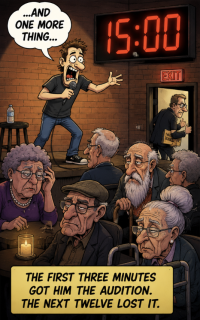
Bring your A-game immediately.

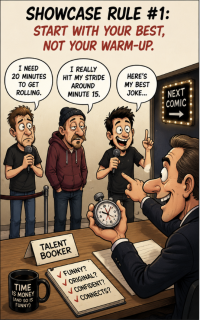
A showcase isn’t the place to ease into your act and “warm up.” You don’t have time. Start strong and make every second count.

It’s also your opportunity to demonstrate professionalism.

When you respect your time limit, you’re showing industry people that you understand schedules, production needs, and the realities of the business. You’re proving that you’ll be easy to work with.

And there’s another reason time limits matter:

Your fellow performers.

Whether a showcase is held in front of a live audience or just a panel of judges, people can only absorb so many short performances before fatigue sets in.

That’s why showcases are designed to move quickly.

Sure, someone like Dave Chappelle can perform for two hours and leave audiences wanting more. He’s earned that ability through decades of experience and a mountain of material.

But if you’re already operating at Dave Chappelle’s level, you probably aren’t showcasing.

One way showcases stay fair is by preventing judges and audiences from becoming burned out before the later performers take the stage.

And that brings me to a story.

In my comedy workshops, ten aspiring comedians perform five-minute sets during our graduation show. That’s 50 minutes of comedy, plus an emcee opening the show and introducing each performer.

The audience begins the evening fresh and excited. By keeping the sets short and focused, energy stays high throughout the night.

A few years ago, the first comedian in the lineup had a strong five-minute set. We had worked hard on it together, and he was prepared.

The problem?

He never looked up.

I was in the back of the room, ready to signal when his time was almost up. But he kept staring at the front tables and never once looked toward the sound booth.

His five minutes ended.

And he kept talking.

The prepared material ran out. Then came the rambling.

Suddenly, the audience wasn’t laughing anymore.

People started looking at menus, chatting among themselves, and ordering drinks. They mentally checked out.

By the time he finally left the stage, the comedian who followed him had to work twice as hard just to regain the audience’s attention.

The damage had been done.

After the show, he came over and asked how he did.

The truth?

“You did ten freaking minutes.”

Okay, maybe I said it with a little more diplomacy than that (not really – I never use the word “freaking”).

But I explained how going long had affected the entire show—not just him, but every performer who followed.

The irony was that his first five minutes were excellent.

The extra five minutes erased much of the goodwill he had earned.

Fortunately, he learned the lesson. He’s still performing today, and talent bookers continue to hire him.

Which brings us back to your original question.

Books by Dave Schwensen

Why are showcases so short?

Because experienced talent buyers don’t need a lot of time to evaluate talent. They’re looking for professionalism, stage presence, confidence, originality, and the ability to connect with an audience.

A strong performer can demonstrate all of that very quickly.

So whether you’re doing a showcase, audition, open mic, or paid gig, remember this:

Respect the clock.

Time on stage can be your greatest ally—or a ticking time bomb.

And as every comedian knows, nobody likes to bomb.

Thanks for reading and as always – keep laughing!!

*

Click on the banner below to sign up for Dave’s free newsletter.

When a club booker asks, “How much do you want?”

Hi Dave – The talent booker for a comedy club sent me the following: “How long is your routine and how much would you want to come to (city) to do a show?” I do 45 minutes to an hour, but on the money question I have no idea how to answer them. Obviously, I’d want enough to cover airfare. Between you and me, I’d stay with my grandmother who lives near the city. Any ideas? Thanks! – B.K.

How much’ya want?

Hey B.K. – I know the club you’re talking about. They’ve been around for years and have a solid reputation. Since you didn’t mention this being a one-night private event or corporate booking, I’m assuming they’re asking about a weekend at the club.

And right away, you’ve run into one of the oldest games in show business.

The talent booker asked you a very open-ended question:

“How much would you want?”

That puts the pressure entirely on you.

Meanwhile, the person asking already knows the going rate for openers, features, and headliners because he’s been booking and paying comedians for years. Clubs that operate every weekend know exactly what comics are worth in their market.

So why ask you?

Because there’s always the chance you’ll come in low just to get the booking.

That’s especially common with newer comedians. Most comics who are still building credits don’t want to scare off a club by quoting too high a number. They’re thinking:

“I just want to get in the door. I’ll negotiate more money later.”

And honestly, that’s understandable.

This is part of the ongoing push-and-pull between bookers and developing talent. Comics with major credits, television exposure, and audience-drawing power can often name their price. Newer comics usually can’t.

That’s simply the reality of the business.

Years ago, when I was booking talent for The Great Lakes Comedy Festival, I contacted representatives for two major television stars for theater appearances. These were household names with hit sitcoms and enormous popularity.

The fees I was quoted were enormous — far beyond the budget of a startup comedy festival. One package even included a private jet to fly the comedian in and out the same night.

And none of it was negotiable.

As long as I’m on TV I set my own price, man!

That’s what leverage looks like at the top level.

But for newer comedians and speakers, the key is learning how to ask better business questions instead of immediately throwing out a number.

Start with this:

“How many shows are you looking for me to do?”

That matters.

Five shows over a weekend is very different from one showcase appearance.

Then ask:

“What do you usually pay your first-time headliners, features, or openers?”

That’s a fair and professional question.

You should also do some research. If you know comedians who have worked the club — and you’re on good enough terms to ask — find out what the club typically pays.

Comedians don’t have a union. Information is often the only leverage performers have.

That said, be respectful. Some entertainers are private about money, and that’s understandable too. Don’t push if someone seems uncomfortable discussing it.

Ideally, the club would simply make an offer upfront:

“This is what we pay first-time features.”

That would make life easier for everyone.

But in the real world, bookers often want to see whether a comedian will undersell themselves first.

You’ll hear this same approach in the corporate, cruise, and college markets too. The difference is that established comedians in those worlds usually already have a set fee structure and know how to negotiate travel, hotel, meals, merchandise percentages, and other expenses.

Club work can be trickier because rates vary wildly depending on the venue, city, audience size, and your drawing power.

A comic consistently earning $1,000 a weekend has established a market value. A comic who’s still building credits may have less negotiating power — especially if the club is taking a chance on booking them for the first time.

That’s why you also have to look at the bigger picture.

Ask yourself:

  • Is this a strong credit for my resume?
  • Will I meet people who could help me get more work?
  • Is this an opportunity to expand into a new market?
  • Would I enjoy the trip personally?
  • Does staying with family reduce my expenses enough to make the deal worthwhile?

In your case, staying with your grandmother could actually become part of the negotiation.

If the club normally provides a hotel room, you might save them money by not needing one. The same goes for transportation if you can borrow a car while you’re there.

But here’s an important reality in today’s comedy world:

Cleveland Comedy Workshop June 2026

Stand-Up Comedy Workshop at The Cleveland Funny Bone

Saturdays noon to 4 pm – June 6, 13 and 27

Perform at The Funny Bone on Wednesday, July 1 at 7:30 pm

For details and registration visit CLEVELAND COMEDY

——————–

A lot of clubs no longer cover airfare the way they once did.

That means you absolutely need to calculate your expenses before agreeing to anything. Know what the trip will realistically cost you. Then compare that number against whatever offer the club makes.

From there, the final question becomes simple:

“Is this worth it for me right now?”

Only you can answer that.

My advice is to stay professional, be honest, and avoid throwing out a random number too quickly. Ask what they’re offering first. Let the booker show his cards before you show yours.

Then negotiate from a position of information — not insecurity.

Thanks for reading and as always – keep laughing!!

*

Click on the banner below to sign up for Dave’s free newsletter.
Running The Light (Going Over Your Time On Stage)

Hey Dave – Without revealing my secret identity, I heard you talking recently about a comedian who went way over his time on stage—and you didn’t sound too happy about it. Safe to say he overstayed his welcome. Care to elaborate? – G.

Did someone give me the light?

Hey G – “Secret identity?” What is this, a spy novel? Don’t worry – I’ll protect your cover. But if you were really undercover, you’d know better than to eavesdrop on my conversations. I tend to go long.

Speaking of going long…

Want to guarantee you won’t get booked again? Ignore the light. Stay on stage. Do another 10… 20… maybe 60 minutes. After all, the audience obviously can’t get enough of you, right?

(And just in case sarcasm doesn’t translate in print – insert a big NOT! right there.)

Here’s the reality: stand-up may be a creative art, but it operates within a very structured business. And one of the biggest unwritten rules is simple – respect your time on stage.

Yes, there are exceptions. If you’re selling out arenas or headlining major tours, audiences expect a longer “concert-style” experience. Think of Bruce Springsteen playing three-hour shows – fans love it, and they paid for it.

But unless you’re at that level, stick to your set time.

Why? Because behind every comedy show is a tightly run operation. Clubs run on schedules – doors open, shows start, staff works, and everything from the kitchen to the bar to the box office is timed around the performance.

Only NO fans!

When a comic goes long, it throws everything off:

  • The box office has already closed
  • Food and drink service has ended
  • Staff is waiting (on the clock) with no way to earn tips
  • The next audience is lining up while the current one is still inside

And here’s something a lot of performers don’t realize: clubs build in “check spots” so customers can pay before the show ends. Run long, and you increase the chances of people slipping out without paying – which often comes out of the server’s pocket.

Not exactly a standing ovation from the staff.

I once had a comedian tell me he was “helping the club” by going an hour over – giving the bar more time to sell drinks. That logic deserves a bigger laugh than anything he said on stage.

The business simply doesn’t work that way.

The same goes for corporate and college gigs. Those events run on tight schedules. Go short, you risk not getting paid. Go long, you risk never getting invited back.

Bottom line:

Time isn’t just a suggestion – it’s part of the job.

For newer comics especially, sticking to your time on stage shows professionalism. It tells bookers and managers you understand how the business works – and that you won’t create problems.

And that’s what keeps you working.

I could go on… but I’ll do something that comic didn’t do.

I’ll stick to my time.

Thanks for reading and as always – keep laughing!!

*

Click on the banner below to sign up for Dave’s free newsletter.