How to Sell Humor to People Who Don’t Have a Sense of Humor

Hi Dave – Speaking and comedy both sound like serious business. I’m dead serious about the value of comedy in business – way more serious than folks who don’t know how to laugh. How do I get those humorless folks to seriously see how silly it is to filter out fun from the expressions of ideas? How do I make it pay for me to show them how to make it pay for them? – R.W.

Just try to make us laugh!

Hey R.W. – Here’s something I’ve noticed about the humorous speaking biz. It seems the people who need us the most – and you know the ones I’m talking about, the humorless people – are the last ones to search us out. In fact, I’ll go out on a limb and say the event planners that schedule humorous speakers already understand the value of humor in the business world. And like us, they’re just trying to convince the other people who need it most to use it.

Anyone who knows anything about the value of humor in business and everyday life already know the positives. I won’t get into a long list, but here are a few of my favorites:

  • Less stress
  • Better teamwork
  • Increased productivity and attendance
  • Improved networking

These are topics a lot of serious business speakers and trainers already talk about because their audiences deal with these on a daily basis. It sounds like you’re doing the same with humor as a solution. The way I see it, it doesn’t matter if you’re going to work or cleaning your house. You’re more inclined to actually do it if you can include an element of fun.

Okay, all that is just to show I agree with your point – and I’m sure many readers of this newsletter do also (the humorless people don’t subscribe). It is, as you so eloquently put it, silly to filter out fun from the expression of ideas. But as I see it, here’s your main question:

How do I make it pay for me to show them how to make it pay for them?

Your goal is to get this message to the humorless folks and get paid for it. But keep in mind they aren’t going to hire you to speak anymore than they would subscribe to this newsletter. They don’t understand the value of your message. That means you need to…

Network with event planners (people who can hire you) that already agree with your message.

The best way to do this is to show them what you can do. In other words – get out and speak. And the best places to do this are where both humorous and humorless businesspeople network:

At meetings.

I’ve talked about this in past FAQs and Answers and even shared some excellent suggestions from readers on where to showcase your program.

But for a simple instruction guide…

If you don’t have it already, create a short (20 minutes is probably max) presentation about your topic and volunteer (for free) to speak at various organizations in your area. This could include Rotary Clubs, associations, charities, alumni groups, or whatever else you find. If you’re having trouble putting together a working presentation, check out my book How To Be A Working Corporate Comedian at Amazon.com.

Free gigs for humorous speakers are like comedy club showcases for comedians. You don’t get paid, but you get in front of people who can hire (and pay) you in the future. But that’s only the start. As I’ve also mentioned in previous FAQs And Answers you need to build a list of potential clients (buyers) through these free gigs and stay in touch with them.

It’s called networking.

Personal Experience!

Of course, you should always take a stack of business cards to hand out after your presentation. This is a no-brainer and business common sense. Include your contact information and website and give a card to anyone who even looks at you sideways. Make it easy for them to find you.

Except that’s never a guarantee they’ll contact you. It’s important to give them a reason for you to stay in touch on a regular basis, otherwise you’ll just be another pain in the you-know-what.

Start a blog or send out a weekly or monthly newsletter, (hey wait a minute – that’s how I got you to read this!). Make it informative and entertaining as an incentive for potential clients to at least check it out. Hopefully they’ll subscribe and you’ll become almost like an email family member (like we are right now – correct?).

Again, this makes it easy to find you in case they eventually want to hire you.

But simply handing out business cards can take a long time to build a decent list. You know what I mean – you hand out a bazillion cards and are lucky to hear from one or two people.

So, here’s how to kick-start your contact list:

A great way to building potential clients and continue adding to your contact list is to have a prize drawing whenever you do one of these free programs. It’s up to you what the prize will be. It could be almost anything from a printed transcript of your presentation to a plate of cookies. You could even offer a free or discounted presentation for their company. Use your imagination for this one and offer something you think most of your audience would want.

Here’s a personal example…

At the end of my programs, I announce a drawing to win a free autographed copy of one of my books. It doesn’t matter which book because even if the winner is not into the topic, they’ll know someone who is and can give it as a gift. But to be in the drawing, they have to put a business card with an email address into a basket. The trade-off is that everyone who enters will be added to the mailing list to receive my corporate (not this one!) e-newsletter.

BUT – and this is an important but – I make it clear they can easily unsubscribe through a link in the email. They just need to receive it once. If they like it, they’ll continue to receive it. If not just opt-out and they’ll never hear from me again. And that’s the honest truth.

Everyone who wants to enter puts a business card in the basket. I draw one and that person leaves with a book. I leave the free gig with a basket full of contacts that could possibly turn into paying clients.

So, there you go. How do you reach the people who need your message? Get out and preach the gospel – your ideas – in front of people who already get it. Go to where businesspeople and event planners can see and hear you. Use these free gigs to build your contact list.

There are no guarantees they’ll hire you, but at least you’re giving them – and yourself – a chance. You need to show them what you can do and stay in touch.

Thanks for reading and as always – keep laughing!!

*

Click on the banner below to sign up for Dave’s free newsletter.

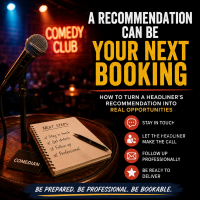
When a Headliner Recommends You

Hey Dave – After a recent showcase, the headliner came up to me and asked if I’d be willing to open for him on his upcoming shows. What’s the best way to approach being a featured comic or host at this major club? I have the manager’s email and a video of my showcase set as a sample of what I can do. I also have a website with my headshot and resume, and I can post the video on YouTube. Sincerely – L.S.

Handing out Golden Tickets!

Hey L.S. – That’s great news! As I’ve said in way too many articles, that’s your Golden Ticket.

A personal recommendation from a headlining comic is always better than trying to do everything yourself through cold calls, blind emails, or simply hanging around the club hoping someone notices you. Those methods can work, but when a comedian who already works at the club is willing to put in a good word for you, you have something much more valuable: an established comic opening the door for you.

That doesn’t mean you should stop promoting yourself. Quite the opposite. Every comedian should have the basic promotional tools in place—a professional website, current headshots, a resume or list of credits, and a good performance video. Those things make it easier for a talent booker to check you out when someone recommends you.

And if you already have a track record—with solid performing credits—you might not have to settle for a showcase. You could end up with a paid booking.

Your next booking?

I’ve seen this happen many times. A headliner will have his or her own opening and feature acts on the road, and the clubs will book the entire “package.” It makes life easier for everyone, including the talent booker.

Stay in Touch With the Headliner

My first piece of advice is simple: stay in touch with the headliner and find out exactly what he has in mind.

Ask questions. Is he talking about having you open his upcoming shows at this particular club? Does he want you to feature for him on a series of dates? Is he considering taking you on the road to open for him at several clubs over the next few weeks or months?

Don’t assume you know what he meant. Get the details.

You can also do a little homework yourself. Check the headliner’s website and social-media pages to see where he’s scheduled to perform. Many working comedians keep their online calendars updated for both fans and talent bookers.

And pay attention to how they promote themselves.

Some smart comics advertise on platforms such as Facebook and LinkedIn in the cities and areas where they’re scheduled to perform. They may start promoting a show a week or two in advance, while also directing potential fans to their websites, videos, and other material.

Clubs love it when comedians help promote their shows. And from your perspective, those promotions can also help you build an audience and establish yourself as a working professional.

There’s more about that strategy in the updated version of How To Be A Working Comic—and, yes, that was a blatant book plug.

Let the Headliner Make the Call

Preferably, the headliner should personally contact the club booker or manager and recommend you for the shows.

He can tell the booker, “I’d like L.S. to open for me,” and then tell you to expect a call or email. Or he can simply make the arrangements and get back to you with the details.

Either way, the important thing is that the headliner—or his agent—personally communicates the recommendation to the club.

That one phone call or email can cut through a lot of red tape.

Why?

Because otherwise, the booker may not know whether the headliner actually recommended you or whether you’re simply using his name to get through the door.

And I’m not singling you out. This happens with every comedian a booker doesn’t know.

You’d be surprised how many comics “drop names” without actually having that comic’s recommendation. I’ve had it happen to me, and it never works in the name-dropper’s favor.

There are plenty of club bookers who can relate to that experience. And I’ve seen comedians post online about situations where they assumed a headliner had recommended them—only to discover that the headliner had never actually contacted the club.

Don’t be that comedian.

If the Headliner Says, “You Contact Them”

What if the headliner doesn’t follow through—or simply says, “Just contact the booker and tell him I recommended you?”

That’s Plan B.

Send the club booker a brief, professional email explaining that you recently spoke with the headliner about opening for him at the upcoming shows.

Then ask for the correct procedure for submitting your promotional material.

Don’t immediately send a huge attachment package with your life story, 14-minute video, six headshots, and a resume that dates back to high school.

Keep it simple.

If the booker asks for your website and video, send the links. If they want a specific performance clip, send that. Give the booker exactly what was requested and make it easy to watch your material.

Your showcase video may be perfect because it demonstrates what you can do in front of an audience. Your website can then provide additional information, including your headshot, credits, upcoming appearances, and other performance material.

And if you don’t hear back?

Wait about a week to ten days and follow up.

The goal is to stay on the booker’s radar without becoming a pain in the you-know-what.

Know what I mean?

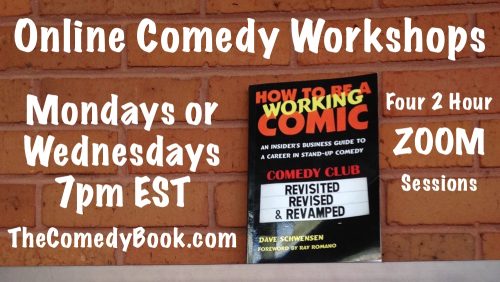
Starts Monday, Sept 14 and Wednesday, Sept 16 – visit above LINK for details!

Use Your Golden Ticket

I’ve written plenty about promoting and marketing your comedy career through emails, postcards, phone calls, websites, social media, and other methods, so I won’t repeat all of that here. There are also plenty of marketing suggestions in Comedy FAQs And Answers and How To Be A Working Comic.

Did I mention I’m into marketing and promotion?

Ha!

But the bigger lesson here is that self-promotion works best when it’s supported by a personal recommendation.

You can have a great video, a terrific website, an impressive resume, and a professional headshot. Those tools are important. But when a headliner who already works at the club says, “I want this comic to open for me,” you suddenly have something you can’t create with a Facebook ad or cold email.

You have credibility.

That’s your Golden Ticket.

Use it.

Thanks for reading and as always – keep laughing!!

*

Click on the banner below to sign up for Dave’s free newsletter.

The Comedy Business Secret: Let Clients Sell You

Hey Dave – You had an article a while back about using quotes from clients as promotion on websites. I’ve been doing sets for some local businesses and clubs and the people who hire me say they like what I do. Can I just take what they say and post it on my website, or do I need it in writing? How do I get these quotes? I want to move into doing better paying corporate shows. Thanks – H.P.

Great idea!!

Hey H.P. — You have a good memory. I ran an FAQ a while back about using “Blurbs and Letters of Recommendation.” Since I only keep these ramblings online for about six months before hitting delete, it’s gone into the comedy workshop archives. But because I’m such a generous and caring individual (please try not to laugh too hard), here’s the updated version…

The original article talked about what makes a strong recommendation letter, email, text or DM from a client. At its best, it’s more than a compliment — it’s advertising. It tells future clients what you brought to the event and why they should hire you for their next one. Then you pull a line or two from that recommendation — the “blurb” — and post it on your website or promo material, just like those glowing quotes you see on book covers.

And now that we’re caught up, let’s continue…

Most comedians and speakers already know that getting a recommendation isn’t always automatic. A client may absolutely love your performance, promise to send you a testimonial, and then… disappear into real life. It usually doesn’t mean they didn’t like you. It means work, family, meetings, deadlines and everything else shoved your recommendation to the bottom of the pile.

Or they simply forgot.

What are friends for?

I also think a lot of people view writing a recommendation the same way comedians view helping friends move furniture. They know they should do it… but they keep hoping it somehow goes away on its own.

That’s where this next tip comes in. I learned it years ago from successful speakers and comedians and believe me — it works far more often than it doesn’t.

Always bring a self-addressed stamped envelope to your gigs.

Seriously. I’m not joking.

When the client is praising you after the show — “You were great!” “The audience loved you!” “Best event we’ve had in years!” — don’t just smile, say thanks, and head for the parking lot. Ask for the recommendation right there while the excitement is fresh. When they say yes — and they usually will — hand them the envelope and say, “I’m making this easy for you.”

Before I started doing this, recommendations were hit-or-miss. Once clients had that envelope in their hands, the follow-through rate went way up. Part of it is convenience. Part of it may be guilt. Either way, the system works.

And there’s another bonus.

Some clients may send a formal letter on company or school letterhead that you can scan and post on your website. Others may decide typing an email is easier. Either one works in your favor.

It also helps to send a thank-you email, card or note after the performance — something you should be doing anyway. If you haven’t received the recommendation yet, that follow-up gives you another opportunity to remind them.

And yes — you really should get recommendations in writing.

A verbal compliment is wonderful, but if you’re posting someone’s quote, name, company or photo online, it’s smart business to have written permission. An email is perfectly acceptable. Think of it the same way publishers use written permission for quotes and endorsements on books.

Now… let’s deal with the chronic procrastinators.

Years ago, I heard a highly successful humorous speaker at a National Speakers Association meeting share this strategy. I tried it myself, and it worked beautifully.

If you still haven’t received a recommendation about a week after the gig, call the client. Thank them again for hiring you and ask for feedback about the event. If they start complimenting your performance — which hopefully they will — bring up the recommendation again.

And if they say, “I’ve just been really busy…” here’s the magic line:

“Would it help if I wrote something up for you?”

Again — I’m not making this up.

Tell them you’ll draft something simple they can edit however they want. Explain that recommendations help with future bookings and that event planners and agencies often want to see testimonials before hiring talent.

You’ll practically hear the sigh of relief on the other end of the phone.

You just volunteered to do their homework for them.

Send the draft by email or regular mail. They can approve it, tweak it, put it on company letterhead, sign it, and send it back in the SASE you thoughtfully provided in the first place.


New online comedy writing groups start:

Monday, June 1 and Wednesday, June 3, 2026

Space is limited and pre-registration is required

For details, reviews and to register visit ONLINE WORKSHOPS


Most working comics and speakers probably think this is basic stuff. But newer performers often haven’t considered any of it. I’ve mentioned these ideas in workshops and watched eyes light up around the room. These are simple techniques — and they work.

One reader also suggested something that’s become even more valuable today: video testimonials.

Excellent idea.

Whenever possible, record your performance (with the client’s permission first). If people are praising you afterward, ask if they’d mind saying a few words on camera.

Seriously. Again — I’m not joking.

A short video testimonial from a happy client can be gold for your website or promo reel. It’s always more convincing when someone else is telling the world how great you are instead of you trying to convince them yourself.

Thanks for reading and as always – keep laughing!!

*

Click on the banner below to sign up for Dave’s free newsletter.