Hey Dave – After a recent showcase, the headliner came up to me and asked if I’d be willing to open for him on his upcoming shows. What’s the best way to approach being a featured comic or host at this major club? I have the manager’s email and a video of my showcase set as a sample of what I can do. I also have a website with my headshot and resume, and I can post the video on YouTube. Sincerely – L.S.

Handing out Golden Tickets!
Hey L.S. – That’s great news! As I’ve said in way too many articles, that’s your Golden Ticket.
A personal recommendation from a headlining comic is always better than trying to do everything yourself through cold calls, blind emails, or simply hanging around the club hoping someone notices you. Those methods can work, but when a comedian who already works at the club is willing to put in a good word for you, you have something much more valuable: an established comic opening the door for you.
That doesn’t mean you should stop promoting yourself. Quite the opposite. Every comedian should have the basic promotional tools in place—a professional website, current headshots, a resume or list of credits, and a good performance video. Those things make it easier for a talent booker to check you out when someone recommends you.
And if you already have a track record—with solid performing credits—you might not have to settle for a showcase. You could end up with a paid booking.

Your next booking?
I’ve seen this happen many times. A headliner will have his or her own opening and feature acts on the road, and the clubs will book the entire “package.” It makes life easier for everyone, including the talent booker.
Stay in Touch With the Headliner
My first piece of advice is simple: stay in touch with the headliner and find out exactly what he has in mind.
Ask questions. Is he talking about having you open his upcoming shows at this particular club? Does he want you to feature for him on a series of dates? Is he considering taking you on the road to open for him at several clubs over the next few weeks or months?
Don’t assume you know what he meant. Get the details.
You can also do a little homework yourself. Check the headliner’s website and social-media pages to see where he’s scheduled to perform. Many working comedians keep their online calendars updated for both fans and talent bookers.
And pay attention to how they promote themselves.
Some smart comics advertise on platforms such as Facebook and LinkedIn in the cities and areas where they’re scheduled to perform. They may start promoting a show a week or two in advance, while also directing potential fans to their websites, videos, and other material.
Clubs love it when comedians help promote their shows. And from your perspective, those promotions can also help you build an audience and establish yourself as a working professional.
There’s more about that strategy in the updated version of How To Be A Working Comic—and, yes, that was a blatant book plug.
Let the Headliner Make the Call
Preferably, the headliner should personally contact the club booker or manager and recommend you for the shows.
He can tell the booker, “I’d like L.S. to open for me,” and then tell you to expect a call or email. Or he can simply make the arrangements and get back to you with the details.
Either way, the important thing is that the headliner—or his agent—personally communicates the recommendation to the club.
That one phone call or email can cut through a lot of red tape.
Why?
Because otherwise, the booker may not know whether the headliner actually recommended you or whether you’re simply using his name to get through the door.
And I’m not singling you out. This happens with every comedian a booker doesn’t know.
You’d be surprised how many comics “drop names” without actually having that comic’s recommendation. I’ve had it happen to me, and it never works in the name-dropper’s favor.
There are plenty of club bookers who can relate to that experience. And I’ve seen comedians post online about situations where they assumed a headliner had recommended them—only to discover that the headliner had never actually contacted the club.
Don’t be that comedian.
If the Headliner Says, “You Contact Them”
What if the headliner doesn’t follow through—or simply says, “Just contact the booker and tell him I recommended you?”
That’s Plan B.
Send the club booker a brief, professional email explaining that you recently spoke with the headliner about opening for him at the upcoming shows.
Then ask for the correct procedure for submitting your promotional material.
Don’t immediately send a huge attachment package with your life story, 14-minute video, six headshots, and a resume that dates back to high school.
Keep it simple.
If the booker asks for your website and video, send the links. If they want a specific performance clip, send that. Give the booker exactly what was requested and make it easy to watch your material.
Your showcase video may be perfect because it demonstrates what you can do in front of an audience. Your website can then provide additional information, including your headshot, credits, upcoming appearances, and other performance material.
And if you don’t hear back?
Wait about a week to ten days and follow up.
The goal is to stay on the booker’s radar without becoming a pain in the you-know-what.
Know what I mean?
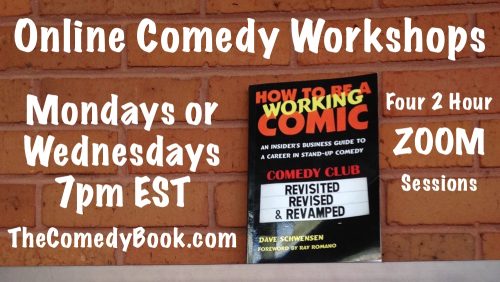
Starts Monday, Sept 14 and Wednesday, Sept 16 – visit above LINK for details!
Use Your Golden Ticket
I’ve written plenty about promoting and marketing your comedy career through emails, postcards, phone calls, websites, social media, and other methods, so I won’t repeat all of that here. There are also plenty of marketing suggestions in Comedy FAQs And Answers and How To Be A Working Comic.
Did I mention I’m into marketing and promotion?
Ha!
But the bigger lesson here is that self-promotion works best when it’s supported by a personal recommendation.
You can have a great video, a terrific website, an impressive resume, and a professional headshot. Those tools are important. But when a headliner who already works at the club says, “I want this comic to open for me,” you suddenly have something you can’t create with a Facebook ad or cold email.
You have credibility.
That’s your Golden Ticket.
Use it.
Thanks for reading and as always – keep laughing!!
*
Click on the banner below to sign up for Dave’s free newsletter.