Meeting a Talent Booker? Ask the Right Questions.

Hola Dave – When meeting a booker, agent, or manager for the first time, are there any important questions a comedian should ask? Should those questions be different depending on who you’re talking to? I’m attending a comedy festival that will be loaded with scouts, and I’d like to be prepared. – A

Who’s askin’?

Hey A – Great question. As I mentioned in my reply to A’s email, I’ve usually been sitting on the other side of the table – as the booker or agent. I’ve also worked with speakers, musicians, and variety acts, so I can tell you what typically happens during that first conversation.

If I couldn’t see a performer live, I’d watch a video. If the act looked promising, I’d review the promotional material – credits, recommendations, training, media appearances, and other experience. If everything suggested a good fit for a particular market, whether comedy clubs, colleges, or corporate events, I’d schedule a phone call or meeting.

That’s a pretty standard process.

During that conversation, I wanted to know where the comedian had performed, what types of venues they worked, and whether they were an opener, feature, or headliner. If we were in the same city, I’d arrange to see them perform live. If we were hundreds of miles apart, video became the deciding factor.

One thing many newer comedians don’t realize is how much this business runs on referrals. Bookers, agents, and producers constantly call each other asking, “Have you worked with this comic?” or “Do you know anything about this performer?”

Do Your Homework First

I’ve got questions!

Many of your questions can actually be answered before you ever introduce yourself.

If you haven’t heard of an agent or booker, research them online. Legitimate industry professionals usually have websites, client lists, social media, or production credits. Find out who they represent and what markets they work in.

Also, talk to other working comedians and speakers. Conversations about agents, bookers, and managers happen constantly. You’ll hear success stories, horror stories, and everything in between. I learned as much sitting around The Improv talking with comics as I ever did in an office.

The Best Question You Can Ask

If I could recommend asking only one question, it would be this:

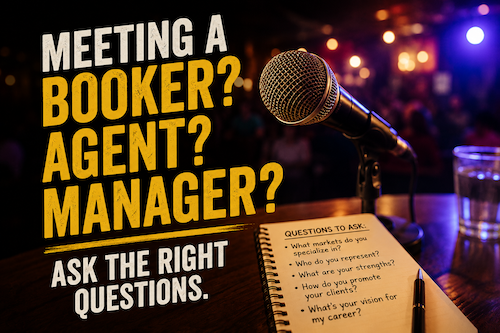
“What markets do you specialize in?”

That answer tells you almost everything.

When I worked in New York and Los Angeles, most agents were focused on television, major comedy clubs, and entertainment opportunities. Later, when I moved to the Midwest, I discovered agencies I’d never even heard of that were incredibly successful booking colleges and corporate events.

When I became involved with the college market through NACA, I discovered many college agents had little interest in television or Hollywood. Their entire business was booking campuses nationwide, and they were excellent at it.

The lesson?

If your goal is television, you need someone who specializes in television.

If your goal is corporate events, colleges, cruise ships, or theaters, you need someone who has relationships in those markets.

Not every representative is built for every career path.

What Not to Ask

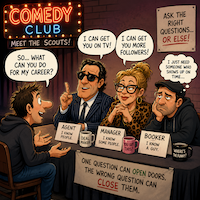
At a first meeting, avoid bringing up commissions, contract percentages, or deal terms unless they introduce the subject first.

If they’re interested in working with you, those conversations will happen naturally. That’s the time to accept, negotiate, or walk away – not during a casual meet-and-greet at a festival.

Remember, the first conversation is usually about getting acquainted. They’ll probably be asking far more questions than you are.

Answer honestly, present yourself professionally, and avoid overselling. Confidence is attractive. Desperation isn’t.

Ask Questions That Fit Your Career

The best questions are always personal to your goals.

Since I know the comedian who sent today’s question – and I also know “Hola” isn’t in my English dictionary – I suggested he ask whether they work in the Latino entertainment market. That’s a huge opportunity, and if that’s part of his career vision, it’s important to know whether a potential representative has the connections to help him succeed in both English and Spanish speaking markets.

The right agent isn’t simply someone who can book you.

It’s someone who can book your career.

New groups start August 2026 – visit SITE for details and to register!


One More Story…

One of my closest friends in New York studied acting at the University of Miami. One of his classmates was a bilingual Cuban actor named Rocky Echevarria.

Early in his career, Rocky found success in Spanish language television. But his agent believed he could also break into mainstream American film and television, so they aggressively pursued English speaking roles.

Rocky eventually changed his professional name to Steven Bauer and landed the role of Manny opposite Al Pacino in Scarface.

Could another agent have helped him get there? Maybe.

But the important point is this: his representative had a vision that matched his long-term career goals – not just his current opportunities.

The Bottom Line

Whenever you have the chance to meet an agent, manager, or talent booker, don’t focus on what they can do for you next week.

Find out where they work, who they represent, and whether their strengths align with the career you’re trying to build.

The right representative can open doors.

The wrong one may keep you knocking on the same doors for years.

Choose wisely – and don’t be afraid to ask the questions that matter.

Thanks for reading and as always – keep laughing!!

*

Click on the banner below to sign up for Dave’s free newsletter.

Don’t send that video… yet

Hey Dave – What’s a good way to promote myself as a comedian and my videos to talent bookers? Can I send them to a video posted on YouTube, Facebook, Instagram? – BT

Are you ready?

Hey BT – I’m not revealing any kind of marketing breakthrough by saying almost everything today is done online. Okay, in my opinion in-person showcases are always the best, but not always easy to schedule – especially if promoting yourself for gigs not within easy travel distance.

And believe it or not, there are still a few (very few) talent bookers that request hard copies of promotional packages. In my opinion it just means they’re out of touch with what’s going on. If they can’t get online and learn how to work with streaming video and website links, what kind of gigs are they getting for their clients?

I’m guessing Amish barn-raisers.

What used to be included in a hard-copy promotional package is what still needs to be included when you promote yourself online. And a dedicated website – rather than social media – is considered more professional and even required by some bookers I’ve worked with if you want to be considered for work.

But don’t be discouraged if you don’t have a big-time website with a lot of bells and whistles dedicated strictly to your comedy or speaking career. One or two pages with the necessities (video, photo, resume, bio) will do the trick until you hit headline or television star status and can hire a publicist to do the work for you.

Are you sure?

Here’s some insider advice:

Great promotional material might get you noticed, but talent and experience are what gets you hired. Basically, it’s still all about writing and performing. That part of the job never ends. But when you’re ready to take the next step in your career, you’ve got to let people know – and that’s when professional looking promotional material and marketing techniques come into play.

Notice one of the words used above – professional. Here’s one of the most important lines from my book Comedy FAQs And Answers:

“They may call it amateur night – but no one is looking to hire an amateur.”

Sharing your videos with friends is easy on YouTube, Facebook, and others. Millions of people do it every day. Just send a message asking them to watch your video and include a link. But when it comes to promoting yourself to get professional bookings, you need to realize that your video and website are important marketing tools.

Go back the word I used earlier – professional.

Once you have a professional looking video and a professional looking website, then you can start contacting bookers to look at it. This is done through networking (meaning you know someone that can recommend you or put you in contact with the booker), researching, (going to the booker or club’s website and finding the required way to submit promotional material or request a showcase), and/or (and I hate this one, even though I’m good at it) cold calling. With the cold call you basically want to get the correct information on how to submit your material to a booker and then follow it.

Now this is not going sound too friendly or supportive, but I have to say it…

To the writer of this question – and don’t get angry because no one else reading this knows who you are – I’ve watched the YouTube link you sent. Here’s some good advice. Do NOT promote it to comedy talent bookers. It comes off as being very amateur and could damage your chances of being seen later when you’ve gained enough on-stage credits and experience to be taken seriously for paid gigs.

No booker has time or interest in watching really bad amateur videos. Take my advice on this one. Plus, it could come back to haunt you.

I remember a very influential comedy booker when I was working in New York City. I saw a comedian who was very funny and mentioned that he should check him out. I was surprised to be told he had seen the comedian a few years earlier when he was just starting his career. Based on that early impression, the booker said the comic was terrible and he had no interest in hiring or even showcasing him.

Here’s my advice.

Don’t worry about promoting yourself for work until you’re truly ready to be hired. Seriously. Be honest with yourself. If you’re doing open-mics or smaller shows and honestly feel you’re just as good or better than others getting paid gigs (listen to your audio recordings – audiences won’t lie), then make the leap. If not, don’t rush it. The best comics and people hiring comics all know it takes time, dedication, and experience. There are no short cuts.

Then promote your career as if you deserve to be called a working comic. This includes a headshot, resume with on-stage credits, a short bio (so they know something about you) and reliable contact email and phone number. You can have all that stuff on a website and in any design or format you want that makes it easy for talent bookers to review.

But the most important part of a promotional package is your video. Don’t put out something that makes you look like an amateur just to have a video to submit. Think of the first impression you’re making and that there might be a good chance the talent booker will remember it. For a long time.

They may call it amateur night – but no one is looking to hire an amateur.

Thanks for reading and as always – keep laughing!!

*

Click on the banner below to sign up for Dave’s free newsletter.

Why Do Talent Bookers Organize Showcases?

Hey Dave – You’ve talked about showcasing in the last few newsletters. What’s the motivation for a talent booker to organize these showcases? What’s the benefit to the booker and the club? — MB

Hey MB – The simple answer is this: showcases exist to find talent.

Whether it’s a comedy club talent booker, casting director, television producer, event planner, or speaker bureau, they all have the same goal – to see performers in action before hiring them.

Yes, they watch videos. Everyone does.

But if you’re in a major entertainment market like Los Angeles or New York, there are far more opportunities to watch performers live. And live tells you things that a video never can.

Think about your favorite band. Watching them on YouTube is one experience. Seeing them perform in concert is something completely different. The same is true for comedians and speakers.

What Talent Bookers Are Really Looking For

When I worked for The Improv in Los Angeles and New York, I regularly received calls from casting directors looking for very specific performers. Sometimes it was for a sitcom, movie, documentary, commercial, or a one-time appearance on a late-night television show.

One of the most competitive showcases we hosted was for The Tonight Show.

The producers weren’t simply looking for funny comedians. They were looking for comics who were funny and experienced enough to handle the pressure of national television. They wanted performers who could walk on stage, deliver under the lights, and not freeze in front of the cameras.

If you had only five minutes of material and were hoping to hit the lottery, this wasn’t your audition.

Why Three Minutes Is Enough

Rather than spending weeks reviewing hundreds of submissions, producers could schedule one showcase and watch a carefully selected group of comedians perform live.

Most comics were given about three minutes.

That may sound short, but experienced talent bookers can learn a tremendous amount in three minutes. They can evaluate stage presence, confidence, originality, audience connection, professionalism, and, of course, whether the performer consistently gets laughs.

I used the same system as Talent Coordinator for A&E’s An Evening at the Improv.

After reviewing stacks of audition videos, I’d invite about ten comedians to perform at a Monday night showcase. Each comic did three minutes, so the entire showcase lasted only about half an hour.

There was never a quota for how many comics we’d book.

One week we might discover four or five performers ready for television. The following week, none.

That’s simply the nature of scouting talent.

A Real-World Example

One evening at the New York Improv, I received a call from The Today Show.

It was an election year, and the producers wanted a comedian who performed political material.

Instead of launching a nationwide search, I contacted ten comedians from our roster who specialized in political comedy and scheduled a showcase.

Each comic performed three minutes.

The producers came to the club, watched everyone in one evening, and selected the performer they wanted.

It saved them from reviewing hundreds of videos and scheduling countless auditions. They made one trip, saw everyone under identical conditions, and left with exactly what they needed.

That’s the real value of a showcase.

Group Comedy Writing Workshops

Next round of online comedy writing workshops start Monday, July 6 and Wednesday, July 8, 2026

Space is limited and pre-registration is required

For details, reviews and to register visit ONLINE comedy workshops


Why Agents and Managers Love Showcases

Showcases aren’t just organized by talent bookers.

Agents and managers often book showcase time at clubs like The Improv and fill the lineup with comedians from their own roster.

Then they invite casting directors, producers, network executives, talent buyers—and in the case of managers, talent agents they hope will represent their clients.

Yes, organizing these events takes work.

But it’s far more efficient than emailing promotional packages, making dozens of phone calls, and trying to schedule individual meetings.

Everyone who matters is in the same room at the same time.

A successful showcase becomes part audition, part networking event, and part business meeting.

What’s the Benefit for the Club?

Hosting industry showcases brings prestige – and business.

Imagine owning a comedy club that’s regularly visited by producers from major television shows, film studios, streaming platforms, and talent agencies.

Where do ambitious comedians want to perform?

That club.

And when the best comedians want your stage, audiences follow.

That’s why clubs compete just as hard to host industry showcases as comedians compete to perform in them.

Showcases Aren’t Just for Comedians

The same principle applies to humorous speakers.

When I worked as an agent booking college entertainment through the National Association for Campus Activities (NACA), showcases were the primary way speakers and comedians landed college bookings.

At regional NACA conferences, colleges sent student activities representatives to watch live showcases over several days.

Comedians, motivational speakers, musicians, hypnotists, and other entertainers each performed approximately twenty-minute sets.

After seeing them live, the student delegates selected who they wanted to bring to their campuses during the upcoming school year.

If you wanted college bookings, you had to be seen.

The Bottom Line

Whether you’re pursuing comedy clubs, television, corporate events, or speaking engagements, showcases remain one of the most efficient ways for buyers to discover talent.

For talent bookers, it’s an organized way to evaluate performers.

For clubs, it’s an opportunity to build reputation and attract top acts.

And for comedians and speakers, it’s a chance to perform in front of the people who can actually hire you.

When you’re ready, there are few opportunities more valuable than getting on the right showcase stage.

Thanks for reading and as always – keep laughing!!

*

Click on the banner below to sign up for Dave’s free newsletter.