
Hey Dave – You’ve written about how important it is to stay within the amount of time you’ve been given on stage. My question is: Why are showcases so short? In most cases, I don’t think you have enough time to prove how good you really are. – S.K.
Hey S.K. – First, for anyone new to comedy or professional speaking, a showcase is simply another word for an audition.
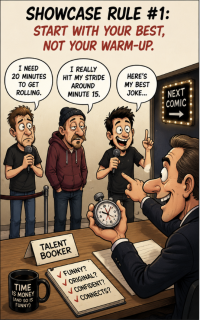 A successful showcase can lead to paid work, television appearances, club bookings, corporate gigs, or even representation from an agent or manager.
Why do we call it a showcase instead of an audition? I’m not sure. Maybe it sounds more professional and less intimidating. Either way, the goal is the same: someone is deciding whether or not to hire you.
I’ve been involved in showcases for comedy clubs, television shows, corporate events, and college programs. Here’s a behind-the-scenes truth about the business:
The people doing the hiring want to make the best use of their time.
Talent bookers, agents, managers, and event planners don’t want to spend an entire evening watching one performer. It makes far more sense to watch several performers in a single session.
They also don’t want to sit through 10-, 20-, or 30-minute sets when they already know within the first few minutes that a performer isn’t what they’re looking for.
That’s why showcases feature multiple acts doing short sets.
For example, when I was auditioning comedians for A&E’s An Evening at the Improv, I scheduled showcases on Monday nights at The Improv in Los Angeles. We’d see ten comedians perform three-minute sets in about 35 minutes. The extra time was built in for introductions and transitions.
If everyone respected the clock, Mission Showcase was accomplished.
In just over half an hour, ten comedians had an opportunity to book a television appearance.
And it wasn’t just me in the room.
Talent scouts from The Tonight Show, HBO, MTV, and other networks knew these Monday-night showcases were happening. Everyone could evaluate a lot of talent in a short amount of time.
 Of course, some comedians complained that three minutes wasn’t enough time to show what they could do.
They were wrong.
Three minutes is plenty of time for an experienced talent booker to know whether a performer is ready.
If you couldn’t convince me within three minutes that you belonged on An Evening at the Improv, then you weren’t ready for that particular show.
The same was true for the other bookers in the room.
Think about it: If a comedian can’t hold attention for three minutes during a showcase, why would a television producer trust that comic with three minutes of airtime?
Even if the performer somehow became hilarious in minute six, television viewers would already be changing channels.
The same principle applies to shows like America’s Got Talent, American Idol, and The Voice. Before contestants ever appear on television, thousands audition in front of producers and judges for only a few minutes—or sometimes less.
If they don’t make an impression quickly, they don’t move on.
The lesson?
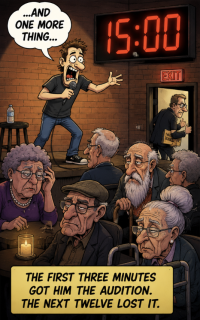 Bring your A-game immediately.
A showcase isn’t the place to ease into your act and “warm up.” You don’t have time. Start strong and make every second count.
It’s also your opportunity to demonstrate professionalism.
When you respect your time limit, you’re showing industry people that you understand schedules, production needs, and the realities of the business. You’re proving that you’ll be easy to work with.
And there’s another reason time limits matter:
Your fellow performers.
Whether a showcase is held in front of a live audience or just a panel of judges, people can only absorb so many short performances before fatigue sets in.
That’s why showcases are designed to move quickly.
Sure, someone like Dave Chappelle can perform for two hours and leave audiences wanting more. He’s earned that ability through decades of experience and a mountain of material.
But if you’re already operating at Dave Chappelle’s level, you probably aren’t showcasing.
One way showcases stay fair is by preventing judges and audiences from becoming burned out before the later performers take the stage.
And that brings me to a story.
In my comedy workshops, ten aspiring comedians perform five-minute sets during our graduation show. That’s 50 minutes of comedy, plus an emcee opening the show and introducing each performer.
The audience begins the evening fresh and excited. By keeping the sets short and focused, energy stays high throughout the night.
A few years ago, the first comedian in the lineup had a strong five-minute set. We had worked hard on it together, and he was prepared.
The problem?
He never looked up.
I was in the back of the room, ready to signal when his time was almost up. But he kept staring at the front tables and never once looked toward the sound booth.
His five minutes ended.
And he kept talking.
The prepared material ran out. Then came the rambling.
Suddenly, the audience wasn’t laughing anymore.
People started looking at menus, chatting among themselves, and ordering drinks. They mentally checked out.
By the time he finally left the stage, the comedian who followed him had to work twice as hard just to regain the audience’s attention.
The damage had been done.
After the show, he came over and asked how he did.
The truth?
“You did ten freaking minutes.”
Okay, maybe I said it with a little more diplomacy than that (not really – I never use the word “freaking”).
But I explained how going long had affected the entire show—not just him, but every performer who followed.
The irony was that his first five minutes were excellent.
The extra five minutes erased much of the goodwill he had earned.
Fortunately, he learned the lesson. He’s still performing today, and talent bookers continue to hire him.
Which brings us back to your original question.

Books by Dave Schwensen
Why are showcases so short?
Because experienced talent buyers don’t need a lot of time to evaluate talent. They’re looking for professionalism, stage presence, confidence, originality, and the ability to connect with an audience.
A strong performer can demonstrate all of that very quickly.
So whether you’re doing a showcase, audition, open mic, or paid gig, remember this:
Respect the clock.
Time on stage can be your greatest ally—or a ticking time bomb.
And as every comedian knows, nobody likes to bomb.
Thanks for reading and as always – keep laughing!!
*
Click on the banner below to sign up for Dave’s free newsletter.


