Running The Light (Going Over Your Time On Stage)

Hey Dave – Without revealing my secret identity, I heard you talking recently about a comedian who went way over his time on stage—and you didn’t sound too happy about it. Safe to say he overstayed his welcome. Care to elaborate? – G.

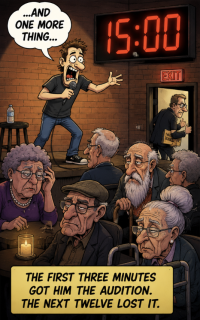
Did someone give me the light?

Hey G – “Secret identity?” What is this, a spy novel? Don’t worry – I’ll protect your cover. But if you were really undercover, you’d know better than to eavesdrop on my conversations. I tend to go long.

Speaking of going long…

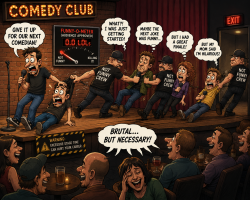
Want to guarantee you won’t get booked again? Ignore the light. Stay on stage. Do another 10… 20… maybe 60 minutes. After all, the audience obviously can’t get enough of you, right?

(And just in case sarcasm doesn’t translate in print – insert a big NOT! right there.)

Here’s the reality: stand-up may be a creative art, but it operates within a very structured business. And one of the biggest unwritten rules is simple – respect your time on stage.

Yes, there are exceptions. If you’re selling out arenas or headlining major tours, audiences expect a longer “concert-style” experience. Think of Bruce Springsteen playing three-hour shows – fans love it, and they paid for it.

But unless you’re at that level, stick to your set time.

Why? Because behind every comedy show is a tightly run operation. Clubs run on schedules – doors open, shows start, staff works, and everything from the kitchen to the bar to the box office is timed around the performance.

Only NO fans!

When a comic goes long, it throws everything off:

  • The box office has already closed
  • Food and drink service has ended
  • Staff is waiting (on the clock) with no way to earn tips
  • The next audience is lining up while the current one is still inside

And here’s something a lot of performers don’t realize: clubs build in “check spots” so customers can pay before the show ends. Run long, and you increase the chances of people slipping out without paying – which often comes out of the server’s pocket.

Not exactly a standing ovation from the staff.

I once had a comedian tell me he was “helping the club” by going an hour over – giving the bar more time to sell drinks. That logic deserves a bigger laugh than anything he said on stage.

The business simply doesn’t work that way.

The same goes for corporate and college gigs. Those events run on tight schedules. Go short, you risk not getting paid. Go long, you risk never getting invited back.

Bottom line:

Time isn’t just a suggestion – it’s part of the job.

For newer comics especially, sticking to your time on stage shows professionalism. It tells bookers and managers you understand how the business works – and that you won’t create problems.

And that’s what keeps you working.

I could go on… but I’ll do something that comic didn’t do.

I’ll stick to my time.

Thanks for reading and as always – keep laughing!!

*

Click on the banner below to sign up for Dave’s free newsletter.

Comedy Festival Submission Tips

Hey Dave – I have submitted to a few comedy festivals each year over the past few years. It can get pretty costly, so I limit myself to only three or four a year. Other than the general submission of filling out the forms and sending in a link to a video, are there some tips to getting noticed and accepted into these festivals? Thanks and I always look forward to receiving your weekly letters. – RT

Enter the unknown

Hey RT – Here’s one thing I love about the comedy industry:

The unknown.

Ask ten comics or industry people how to get into festivals and you’ll get ten different answers. I’ve spent plenty of late nights in clubs and NYC diners listening to debates about trends, formulas, and “what works.” Then – WHAM – someone breaks all the rules and changes the conversation.

Think about when audiences first saw George Carlin doing the Hippie Dippy Weatherman… then a few years later delivering “Seven Words You Can Never Say on Television.” That shift didn’t just surprise audiences — it reshaped comedy itself.

That unpredictability is what makes comedy exciting… and sometimes maddening.

So what does that mean for festival submissions?

Carlin Before

Every festival is different. Some are major showcases featuring established names and carefully selected “up-and-coming” talent. Others spotlight local performers or serve as a celebration of a city’s comedy scene. Some have themes. If it’s a “Women in Comedy” festival, guys won’t make the lineup. If it’s a clean comedy event, explicit material won’t help your chances.

And beyond all of that — there’s taste. The people reviewing submissions have their own preferences, their own goals for the show, and their own vision of what fits. Unless you’re in that room, you simply can’t predict what they’re looking for at that moment.

That’s the unknown factor.

Connections can also play a role. Festival organizers often hear recommendations from agents, bookers, and comedians they trust. Just like agents keep tabs on who’s consistently working strong clubs, festival producers pay attention to buzz and reliability. You never know what background information may help – or hurt – a submission.

Carlin After

Now for the part you can control.

Treat comedy like a business.

Your goal is to be funny, original, reliable, and professional. Festival organizers want performers who help make their event successful. Even if a show features newer comics, no organizer wants an amateur-run experience for their audience.

Your submission video is the single most important tool you have.

Never submit a poor-quality video. Ever.

It no longer takes a big budget to get a clean recording with good audio. A basic camera on a tripod in the back of a club works — as long as the picture is clear and the sound is strong. Bookers want to hear you and the audience response. If they struggle to see or hear your set, they move on.

Also, don’t waste valuable seconds.

Start with material. Not introductions. Not stock lines. Not applause cues. If the first thing they see is you being funny, you’ve already helped your chances.

I recently reviewed a festival submission where the first thirty seconds were the MC’s introduction, followed by standard “Hello city!” and “Give yourselves a hand!” lines. That’s not what bookers are evaluating. They want to know one thing:

Are you funny?

Here’s the bottom line.

You can’t control taste, timing, or trends. But you can control professionalism. A strong video, focused material, and a business-minded approach show you’re serious about the work.

Even if you’re still developing – never present yourself as unprepared.

And remember… sometimes the unknown works in your favor.

Thanks for reading and as always – keep laughing!!

TAMPA, FLORIDA 2026

Standup Comedy Workshop at The Tampa Funny Bone:

Saturdays – March 14, 21 and 28 from 12:30 to 4:30 pm.

Performance at The Funny Bone – Wednesday, April 1 at 7 pm

Space limited – for details and to register visit COMEDYWORKSHOPS.

*

Click on the banner below to sign up for Dave’s free newsletter.

Clean or Dirty? You’d better know your audience

Hi Dave – I have one question. As a new comedian does my material have to be clean? – J.N.

Have a decision to make!

Hey J.N. — you’re not alone. This question comes up all the time, and new comedians ask it for a good reason: it matters.

Here’s the short answer upfront (because I’m rarely accused of giving one):

There is no right or wrong answer.

Comedy is both a creative art and a business, but before either of those things matter, there’s one primary goal:

Be funny.

How you get there is completely up to you.

A very famous comedian once told me (and I included this in my book How To Be A Working Comic):

“If you swear in real life, you’re going to swear on stage.”

That makes sense. If those words are already part of who you are, they’ll naturally show up in your act. But if they aren’t—don’t add them because you think they’ll make you funny. Audiences can smell that a mile away, and “trying to be edgy” is never as funny as being honest.

There’s a market for everything. Whether you choose to work clean or adult is a personal decision.

But since you asked – and once again, I’ve never been known for short answers – let’s look at this from a different angle.

We’ll call it…

Your Audience

But will they laugh?

You specifically said new comedian, so let’s start there.

When you’re beginning, your job is simple:

Get stage time. Learn how to write. Learn how to perform. Learn how audiences respond.

Along the way, you’ll encounter different rooms, different crowds, and very different expectations.

  • Some comedians love late-night, beer-soaked club crowds.
    Others prefer corporate events, colleges, or private functions.
  • Right now, it’s probably too early to know which lane you’ll ultimately choose—and that’s okay. But eventually, this becomes both a creative and business decision, because different markets hire different kinds of comics.

So here’s the real question behind your question:

Who do you want your audience to be?

Every entertainer has to answer that—not just comedians. As a creative artist, who do you want to make laugh? And as a businessperson (yes, that’s you), how will you build an audience that supports your work?

When you’re starting out, that audience could be anyone: open mics, bar shows, fundraisers, showcases. What matters most is experience. You don’t become a working comic by rehearsing in your living room or performing for the family dog.

You get better by getting on stage.

  • If they laugh, it works.
  • If they don’t, it doesn’t.

Audiences are honest that way—which is why stage time is priceless.

https://youtu.be/mu1F3ck5ZgE?si=AuPP001eW_GOKONc

Know the Room

Would your audience want clean material or adult material?

That’s not a moral question. It’s a practical one.

I’ve coached Born Again Christian comics and the most X-rated acts you can imagine. I don’t care which direction someone chooses—as long as they’re clear about it and performing for the right audience.

  • But make no mistake: there are rules in this business.
  • And those rules are made by the people who hire comedians.
  • You can’t do X-rated material on network television. Cable and satellite radio allow more freedom—but even then, context matters. The Disney Channel and The Howard Stern Show aren’t fighting over the same talent pool.

So ask yourself:

  • Where do you want to perform?
  • Who do you want laughing?
  • Which markets excite you?

You can work dirty—just don’t do it in front of grandparents who brought their grandkids for a fun night out. And don’t expect your clean, church-friendly material to crush in a late-night dive bar full of people upset that the bartender turned off cage-match wrestling for a comedy show.

Get the picture?

Experience Changes Everything

Many experienced comics can work both clean and adult. Why? Because their jokes are funny on their own—not because of an F-bomb. They can adjust based on the room.

A perfect example: cruise ship comics.

They perform family-friendly shows before and after dinner, then switch gears later that night for adult-only crowds. Same comedian. Same brain. Two very different sets—sometimes just hours apart.

That kind of flexibility comes from experience.

And one more thing to keep in mind…

The people who hire comics for corporate events, banquets, and private functions pay far more than the beer-soaked guy booking a bar show. That’s why many working comics love corporate gigs.

On the other hand, an uncensored Netflix special or becoming a regular guest on a show like Stern can launch a career just as fast.

Different paths. Same requirement.

So… Clean or Dirty?

As a new comedian, here’s my advice:

Focus on writing funny material—material that works with or without a few choice words. Develop jokes that stand on their own. Learn how to adjust your delivery depending on the room.

Then ask yourself:

  • Would I rather perform at a business luncheon—or a late-night dive bar?

Neither answer is wrong. But knowing your audience will help you find the right one.

And that’s where real comedy careers begin.

Thanks for reading and as always – keep laughing!

Next online comedy workshop groups start

Wednesday, February 11 and Monday, February 16, 2026

Space is limited – for details, reviews and registration visit OnlineWorkshops

*

Click on the banner below to sign up for Dave’s free newsletter.
Business card – got one?

Hi Dave – I’ve decided to order business cards. I was wondering what information I should include. I was thinking phone number, email, and website. Is there anything else I need, or any reason not to include my address? – K.S.

Could use more info…

Hey K.S. – Great decision. I’m always surprised how many comedians or performers still don’t have business cards. Maybe they think it’s a relic from the past—like mailing out DVDs instead of sending a link—but a business card is still an important promotional tool.

How is anyone supposed to know you’re out there and available for gigs if you don’t promote yourself? Unless you’re already a known comic, have a Comedy Central special, or a big-time agent pushing for you, you need to be prepared to handle the business side of your career.

Of course, the first step in any business is to be so good on stage that people want to see you again. That comes from writing, performing, then repeating the process countless times. But once you’re ready to move forward, promotion becomes a major part of your plan. It helps you take advantage of opportunities that can lead to showcases and paying gigs.

Promotion gets your foot in the door. Talent, hard work, and dedication are what get you hired. As I say in my book Comedy FAQs and Answers:

They may call it amateur night, but nobody’s looking to hire an amateur.

Memorize that—it’s true.

Now, your question wasn’t about showcases or all the ways to promote yourself, so let’s talk specifically about business cards.

I write a lot about networking and being part of your local comedy scene because you never know who you’ll meet—someone who could genuinely help your career. But are you prepared when that moment happens?

My latest

Back when I worked at The Improv, comedians would often ask how to get an audition or how to submit a video. Then, instead of handing over a business card, they’d say, “Let me give you my email,” and expect a manager to write it down—or they’d start searching for a bar napkin to scribble on.

Were they nuts? That’s not how you make a professional impression. And in my head, every time someone did that, I’d think: “Amateur…”

Even worse, some comics would just give their name and say, “I’ll send you my link,” or “Keep me in mind for showcases.”

Sorry, but I’m terrible with names. Honestly, there’s a woman interrupting me right now while I’m trying to write this. Her name escapes me… I should remember it—we’re married.

Get the idea?

People like talent bookers, event planners, and club managers deal with a lot of names. Make it easy for them to remember you and contact you. Business cards aren’t outdated or uncool. They’re a simple, effective professional tool.

So to finally answer your question:

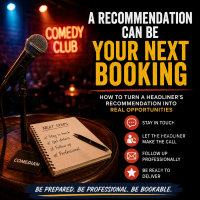
Your business card should include:

  • Your name
  • What you do (comedian, speaker, etc.)
  • Your best contact info
    • Phone
    • Email
    • Website (with video and promo materials)

If you have a blog, newsletter, or podcast that supports your career and is actually interesting, you can include that link too.

Electronic business cards—QR codes, NFC cards, or files you can Airdrop—are also becoming popular. They’re great to have, but not everyone uses them yet. For someone just getting started, keep it simple and carry regular business cards.

A smart move is to design your card so it stands out. A photo or logo works, but if you (or a designer friend) can create something genuinely unique, memorable, or just plain cool, people are far more likely to keep it instead of losing it in a drawer.

On the flip side!

Try out a few designs on any inexpensive business card site—there are plenty—and don’t leave the house without at least a few cards on you. You can update or redesign them any time since they’re cheap and sometimes even free.

If you’re serious about building a career, you have to take promoting and networking seriously. When you meet someone new or stumble into an opportunity, a business card clearly communicates who you are and how to reach you. There’s nothing amateur about that.

One important warning:

Never put your home address on your business card or any promotional material. You don’t know where that card may end up, and the last thing you want is some wacko showing up at your door. Yes, this has happened—to both male and female performers.

A business card isn’t an outdated relic. It’s a simple, professional way to help people find you—and hire you.

Thanks for reading and as always – keep laughing!!

Winter 2026 Standup Comedy Workshop at The Cleveland Funny Bone:

Saturdays – January 10, 17 and 24 from noon to 4 pm.

Performance at The Funny Bone – Thursday, January 29 at 7:30 pm

Space limited – for details and to register visit COMEDYWORKSHOPS.

*

Click on the banner below to sign up for Dave’s free newsletter.
Being Influenced vs. Copying

Hey Dave – I’ve been working on material and continue to search for my comedy voice. Although I want to do some improvising, I want a good amount of material to work off of. Someone said I have a somewhat eccentric and iconoclastic persona and should take advantage of that. Therefore, I’ve thought about using Prof. Irwin Corey and Steven Wright as influences and been writing material similar to theirs, especially since I like it. However, I’m afraid I’m not using them as an influence but just copying them. Is there a thin line between the 2 or just between fishing and standing there doing nothing? – JK

Read and remember!

Hey JK – I was fortunate to work with the late, great Prof. Irwin Corey and with Steven Wright during my years at The NYC Improv. And as I always tell the younger comics: if you don’t know who those guys are, look them up. You’ll learn a lot about the history of stand-up and how much past performers have shaped the headliners we see today.

Both Prof. Corey and Steven Wright are incredibly smart and incredibly funny. I also know that if I ever tried to write like either one, I’d be lost – completely confused. My brain actually hurts just thinking about it. But I do have some thoughts on your question, so instead of standing here doing nothing, let’s go fishing for an answer…

Yes – there is a line between being influenced and copying. Ideally, it should be a wide one.

As Prof. Corey would say, “Let me explain…”

Prof. Irwin Corey

I often compare comedy to music. I’ve done this in my workshops, books, and more than a few FAQs. You can’t reinvent the wheel. Someone had to hum the first tune, and someone had to make the first joke. Musicians and comedians have been building on those firsts ever since.

One of my all-time favorite bands is The Rolling Stones. They’ve influenced countless musicians for more than sixty years – yet there’s still only one Rolling Stones. But even they started by copying their heroes: Muddy Waters, Howlin’ Wolf, Robert Johnson, Chuck Berry, Bo Diddley… the list goes on.

Did they copy? Absolutely.

They played a lot of covers early on. But that’s not what made them legends. Mick Jagger found his own voice. Keith Richards found his. Together they wrote new songs inspired by what they loved – but filtered through who they were.

That’s exactly how comedians develop. They start by emulating what they like.

Keith Richards isn’t going to play Bach when he grew up loving Chuck Berry. And based on how you described your humor, I doubt you’re going onstage with props like Carrot Top or with the kind of sharp-edged commentary Dave Chappelle is known for. You admire Corey and Wright, so of course they’ll influence you – just like Chuck Berry influenced the Stones.

But here’s the big difference between comedy and music:

Steven Wright

The Rolling Stones can play “Johnny B. Goode” in concert. A comedian can’t go onstage and say, “Here’s one from Steven Wright,” and then perform his jokes.

That’s not influence – that’s theft. And yes, there are comedians who do it. And most of us know exactly who they are. The respect level for joke thieves is somewhere below sea level.

Being influenced is not the same as stealing.

Creative artists build on what came before them. A Rolling Stones song might have a Chuck Berry riff or a Bo Diddley beat hiding in the background, but it’s still a Stones song. Likewise, comedians can’t help but be influenced by the style of humor they enjoy.

Carrot Top didn’t invent prop comedy. Every kid who ever held paper plates to their head and pretended to be Mickey Mouse dabbled in prop comedy. He took what he liked and built on it.

That’s what you need to do.

You understand your comedic style. It’s reminiscent of Corey and Wright, but you’re not Corey and you’re not Wright – and that’s the point. You didn’t grow up in their neighborhoods, their families, their jobs, or their lives. You have your own stories, experiences, personality, and point of view.

That’s where your material has to come from.

Don’t ask, “What would Steven Wright say?” Ask, “What do I think about this?” Respect your influences, borrow the sensibility you appreciate – but say things in your own words with your own brain.

When I worked in Los Angeles, I worked with Jim Carrey and Michael Richards (Kramer from Seinfeld). Both were massive Jerry Lewis fans. But neither went onstage yelling, “HEY LAAYYYDEEE!” That would’ve been stealing. But they did incorporate Lewis-style physicality, wild expressions, and pratfalls – filtered through their own personalities and experiences. And Jerry Lewis, of course, had been influenced by Chaplin and Harpo Marx.

That’s how influence works.

Use your natural mannerisms, your personality, and your experiences to shape your material. Don’t hold paper plates up to your head and hope the audience laughs – dig deeper. Think about why something is funny to you and how you see it. Then present that.

Everyone is influenced by someone. None of us are inventing the wheel – we’re just putting better tires on it. The key is understanding what makes you unique and exploring material that fits your comedic point of view.

Keep writing. Keep performing. Your comedy voice will emerge. And one day, when someone asks who influenced you, you’ll have your answer – just like every successful comedian does. The turning point is when you stop copying and start building on what inspired you in the first place.

Thanks for reading and as always – keep laughing!!

Click on the banner below to sign up for Dave’s free newsletter.
Humorous speakers – it’s more than telling jokes

Hi Dave – I do a lot of presentations through my job. These are specific to the industry, and I’d like to start speaking at related conferences. I’m not a stand-up comedian but know the importance of humor in getting my message across to an audience. Many of my friends think I am funny in an “I Love Lucy” kind of way… Which I suppose comes naturally. However, I am not sure how to release that side of me when I am giving a humorous presentation. Thanks – DB

Not funny!

Hey DB – When it comes to giving a humorous presentation – or performing as a comedian – the most important goal is to connect with your audience. That’s the bottom line. If you don’t connect, they won’t listen.

And one of the best ways to connect is to be yourself – to let your natural personality shine through.

Let me explain…

Working comics know that stand-up is more than just telling jokes. Anyone can tell a joke, but to be successful, you have to show who you are on stage. Comics, agents, and bookers call it your comedy voice. For speakers, I like to call it who you are on stage.

Look at legends like Rodney Dangerfield and Henny Youngman (and if you don’t know these guys, brush up on your comedy history). Their personalities made their material unforgettable. They could deliver quick, clever one-liners, but what really sold those jokes was them – their character, rhythm, and delivery.

Who? Me?

Fans could retell their jokes the next day at school or around the office water cooler, but the laughs were never quite the same. Why? Because they didn’t have Rodney’s hangdog face or Henny’s sharp timing. Their personalities made the jokes work.

Dangerfield’s humor came from his self-deprecating style – “I get no respect.”

Youngman was the wisecracker – “Take my wife… please!”

Without those distinct personalities, their jokes would have been forgettable.

The same goes for humorous speakers.

I often see speakers try to be “funny” by tossing in a random joke they found online or by reworking an old one to fit their topic. They think this makes them a humorous speaker – but it usually comes across as forced or phony.

Yeah – you!

I’ve seen it too many times: speakers hiding their natural personalities because they think being professional means being serious. That’s fine if your goal is to be strictly informational – but if you want to be memorable, engaging, and genuinely funny, you have to bring your real self to the stage.

So, your friends say you remind them of Lucille Ball. There’s truth in that. I’m sure you’re not trying to imitate Lucy – you just share some of her qualities naturally. That’s part of your charm, and it’s something you can use.

You don’t have to recreate her candy factory scene or hang off the side of a building to channel your inner Lucy. Her comedy wasn’t just slapstick – it was also about timing, expression, and physical energy. Maybe it’s the way you tell a story, use gestures, or react to a situation. Whatever it is, that’s your version of Lucy – and that’s what will connect with an audience.

Here’s the key:

Don’t tell jokes. Tell stories.

If you have stories or examples related to your topic that are naturally funny, lean into them. Use facial expressions, movement, and vocal variety. Keep it natural.

And most importantly – use your personality.

Think about how you talk with your friends. When something funny happens and you tell the story, you probably don’t plan the punchline – you just tell it in your own way, and people laugh. That’s your natural comedic rhythm.

Now imagine your audience as a room full of friends. Deliver your message with that same warmth, spontaneity, and humor. You’ll inform them and entertain them.

People remember speakers who make them feel something – especially laughter. They’ll forget the PowerPoint slides, but they’ll remember you.

That’s how you stand out from the competition.

It worked for Rodney, Henny, and Lucy – and it can work for you, too.

Thanks for reading and as always – keep laughing!!

Click on the banner below to sign up for Dave’s free newsletter.
3 Lessons I Learned From a 30-Year Comedy Veteran – Dave Schwensen

By Siddesh Pai – “I Help Comedians, Humor Keynote Speakers & Entrepreneurs Enhance Their Personal Brand Through Targeted Newsletters | Standup Comedian”

Readers: You can locate Siddesh Pai through the following link on LinkedIn. This is an interview we did earlier this year and I liked it enough to share it. Thanks Siddesh and keep laughing!!

https://www.linkedin.com/in/siddeshpai/

3 Lessons I Learned From a 30-Year Comedy Veteran – Dave Schwensen

Talking comedy

Dave has been working in comedy for three decades. But he wants to make one thing clear: he’s not a stand-up comedian. To me, it felt like a writer who doesn’t read. But that’s exactly what makes him different—he’s spent his career booking, coaching, and writing on the business of comedy. In our conversation, he dropped some serious wisdom on why treating comedy like a business is the key to making it a career.

1) Comedy Can’t Be Taught—But It Can Be Coached

“I don’t believe you can teach comedy. What I think is funny, you might not. My kids certainly don’t think I’m funny.” I can’t tell you the Three Stooges are funny if you don’t find slipping on a banana peel hilarious, there’s nothing he can do to change that. This is where coaching comes in. Every comedian has a different style, a different rhythm, and a different worldview. Dave helps comics refine that—polishing the delivery, cutting the fat from jokes, and shaping a strong act. Because at the end of the day, you can’t teach funny. But you can help someone be funnier.

2) No One Is Going to Hand You Stage Time – You Have to Create It

“You can’t teach timing, you can’t teach delivery, and you sure as hell can’t teach stage presence. You have to get up there and do it.” Most comedians think getting better means hitting open mics over and over. But Dave has a different take – go where the audience actually wants entertainment. Clubs are competitive. You’re performing for other comics, waiting for their turn. But business events, fundraisers, and community groups? They’re desperate for entertainment. Your first gigs might be free, but that’s how you build momentum. One day, you’re performing at a Rotary Club for free. The next, someone offers you $500 to do the same set. Stage time is currency. The more you get, the faster you grow.

3) They Call It Amateur Night, But No One Is Trying to Hire an Amateur

A lot of comedians treat stand-up like a passion project. But the ones who make a career out of it? They treat it like a business. – Networking Matters – Hanging out with comics at open mics isn’t enough. Get to know bookers, producers, and event organizers. These are the people who can actually get you paid work. – Market Yourself – Being funny isn’t enough if no one knows you exist. Build a brand, create content, and stay on people’s radar. Your name should pop up when someone’s looking for a comedian. – Be a Professional – Show up on time. Have a tight five. Be easy to work with. Give people your business card. Make yourself easy to book. The comedians who get booked aren’t just the funniest—they’re the ones who treat it like a business.

Thanks for reading – and keep laughing!

Click on the banner below to sign up for Dave’s free newsletter.
For comments, questions about workshops and coaching please email – Dave@TheComedyBook.com