Comedy Blues and Creative Highs

Hey Dave – I have a confession to make and was wondering if this is normal or not and if so, how to deal with it? Is there such a thing as having the blues in comedy? I guess you could call it the Comedy Blues. I mean, I’ve been told “no” before and had terrible sets in the past. But I strongly feel it has made me the keen comedian I am today. But still, if I may… help! – A.

An instrument for creativity

Hey A. – Congratulations. You’re a creative artist.

And what you’re feeling? It comes with the territory.

A career in the arts—comedy, speaking, acting, music, writing—often means riding an emotional roller coaster. Big highs. Big lows. That’s one reason so many people wish they could do it, but don’t. Standing on stage, getting laughs, meeting fans, and getting paid is a great gig. From the audience, it looks glamorous. What they don’t see is the rejection, the waiting, the self-doubt, and the work.

The people who truly pursue it usually don’t feel like they have a choice. They have to do it.

This may sound more motivational than instructional today but stay with me.

Let’s talk music for a second. Some great songs are about incredible highs. Others are about lows—the blues. Blues songs exist because nothing worth having comes easy. They’re about loss, frustration, and struggle.

Now translate that to comedy.

Creative words from a creative artist

If you’re serious about being a comedian (or humorous speaker), you want things to happen now. But progress is slow. Opportunities are unpredictable. Yes, there are huge highs—your first paid gig, passing an audition, winning a contest. But there are also long stretches where nothing clicks, nothing moves, and doors stay closed.

Here’s the truth: every working comic will tell you that you’ll hear “no” far more than “yes,” especially early on.

That’s not a flaw in the system. That is the system.

If you want to stay in this business long enough to build a career, you need to develop thick skin. There’s no shortcut around it.

Think of it like sports. The best relief pitchers in baseball blow saves. What separates them from the ones who spiral or disappear is their ability to shake it off and throw the next pitch with confidence. That mindset has to be learned—or developed quickly—if you want to survive in a competitive field.

Comedy is exactly that: a creative art inside a competitive business.

You put your work—and yourself—out there to be judged by bookers, producers, and audiences. Some will love it. Some won’t. The goal isn’t avoiding highs and lows. The goal is not letting either one define you.

I remember working in New York and hearing brand-new comics say they planned to have a sitcom within a year. I heard it more than once. Meanwhile, the comics hanging around the NY Improv—Ray Romano, Larry David, Dave Attell (to mention only three)—had been grinding for years. They didn’t get everything they auditioned for. They just didn’t quit when someone said “no.”

Unrealistic expectations create massive lows.

Understanding the process creates resilience.

That process has a name: paying your dues. Some people drop out because they can’t take the lows. Others continue because they’re wired to create—whether success comes quickly or not. Continuing doesn’t guarantee success. Talent, business skills, relationships, and luck all matter. But quitting guarantees nothing.

So, what do you do with the Comedy Blues?

Sometimes you step back and regroup. Sometimes you put your head down and keep going. For many creative artists, there isn’t really a choice.

One final thought: consider using those feelings in your writing.

You don’t need to talk about the Comedy Blues—but bringing real emotion into your material adds honesty and depth. Audiences can spot fake instantly. They can also sense when someone is telling the truth, even through jokes.

Most strong comics and speakers draw from experience. They’ve ridden the roller coaster. They’ve paid their dues.

Remember—this is a creative art.
And being a creative artist has never been easy.

But for those who feel called to it?
It’s the only ride worth taking.

Thanks for reading and as always – keep laughing!!

Winter 2026 Standup Comedy Workshop at The Cleveland Funny Bone:

Saturdays – January 10, 17 and 24 from noon to 4 pm.

Performance at The Funny Bone – Wednesday, January 28 at 7:30 pm

Space limited – for details and to register visit COMEDYWORKSHOPS.

*

Click on the banner below to sign up for Dave’s free newsletter.

Build Potential Clients Contact List

Hi Dave – Speaking and comedy both sound like serious business. I’m dead serious about the value of comedy in business — way more serious than folks who don’t know how to laugh. How do I get those humorless folks to seriously see how silly it is to filter out fun from the expressions of ideas? How do I make it pay for me to show them how to make it pay for them? – R.W.

Seeking Humor Benefits

Hey R.W. — Here’s something I’ve noticed about the humorous speaking business: the people who need us the most are usually the last ones looking for us.

You know exactly who I mean—the humorless folks.

In fact, I’ll go out on a limb and say this: event planners who book humorous speakers already understand the value of humor in business. They get it. Just like we do. Their real challenge is convincing the other people—the ones who need it most—to embrace it.

Anyone who understands the value of humor in business (and in life) already knows the benefits. I won’t list them all, but here are a few favorites:

  • Less stress
  • Better teamwork
  • Increased productivity and attendance
  • Stronger networking and relationships

These are the same issues serious business speakers and trainers talk about every day. You’re doing the same thing, except you’re offering humor as part of the solution.

Humor works!

And honestly, it doesn’t matter whether you’re going to work or cleaning your house—you’re far more likely to do it if there’s an element of fun involved.

So yes, I agree with you completely. It is silly to filter fun out of the expression of ideas. And I’m confident many readers of this newsletter agree too (the humorless folks don’t subscribe).

Which brings us to the real question you asked:

How do I make it pay for me to show them how to make it pay for them?

You want to reach the humorless crowd—and get paid to do it. The problem is, they’re not going to hire you any more than they’re going to sign up for this newsletter. They don’t yet understand the value of your message.

That means you need to focus on the people who do understand it.

Network with event planners and decision-makers who already agree with you.

And the best way to do that is simple: show them what you can do.

In other words—get out and speak.

The best places for this are where both humorous and humorless businesspeople gather:

Meetings.

I’ve talked about this before in past FAQs, and readers have shared some great ideas on places to showcase a program. But here’s a simple starter plan:

Create a short presentation—20 minutes max—on your topic, and volunteer to speak for free at organizations in your area. Rotary clubs, associations, charities, alumni groups, chambers, nonprofits—anything that puts you in front of businesspeople.

If putting together a solid presentation feels overwhelming, I cover this in detail in my book How To Be A Working Corporate Comedian.

Think of free gigs the same way comedians think of showcases. You don’t get paid—but you get in front of people who can pay you later.

But that’s only step one.

You also need to build a list of potential clients and stay in touch with them.

That’s called networking.

Yes, bring a stack of business cards and hand them out after your presentation. That’s basic business sense. Make it easy for people to find you.

But handing out cards alone is a slow game. You can give out a hundred cards and hear from one—or none.

So, here’s how to kick-start your contact list:

Do a prize drawing at every free program.

The prize can be almost anything—a printed transcript of your talk, a plate of cookies, a discounted presentation, even a free one. Use your imagination and offer something your audience would actually want.

Here’s what I do.

At the end of my programs, I announce a drawing for a free autographed copy of one of my books. To enter, people drop a business card—with an email address—into a basket. In return, they’re added to my corporate e-newsletter list.

And this part is important: I make it clear they can unsubscribe easily after receiving it once. No tricks. No pressure.

One person leaves with a book.
I leave with a basket full of contacts who might become paying clients.

That’s a win.

So how do you reach the people who need your message?

You preach the gospel—your ideas—in front of people who already believe. You go where businesspeople and event planners can see and hear you. You use free gigs to build relationships, grow your list, and stay visible.

There are no guarantees they’ll hire you, but at least you’re giving them – and yourself – a chance. You need to show them what you can do and stay in touch.

Thanks for reading and as always – keep laughing!!

Winter 2026 Standup Comedy Workshop at The Cleveland Funny Bone:

Saturdays – January 10, 17 and 24 from noon to 4 pm.

Performance at The Funny Bone – Thursday, January 29 at 7:30 pm

Space limited – for details and to register visit COMEDYWORKSHOPS.

*

Click on the banner below to sign up for Dave’s free newsletter.
Being Influenced vs. Copying

Hey Dave – I’ve been working on material and continue to search for my comedy voice. Although I want to do some improvising, I want a good amount of material to work off of. Someone said I have a somewhat eccentric and iconoclastic persona and should take advantage of that. Therefore, I’ve thought about using Prof. Irwin Corey and Steven Wright as influences and been writing material similar to theirs, especially since I like it. However, I’m afraid I’m not using them as an influence but just copying them. Is there a thin line between the 2 or just between fishing and standing there doing nothing? – JK

Read and remember!

Hey JK – I was fortunate to work with the late, great Prof. Irwin Corey and with Steven Wright during my years at The NYC Improv. And as I always tell the younger comics: if you don’t know who those guys are, look them up. You’ll learn a lot about the history of stand-up and how much past performers have shaped the headliners we see today.

Both Prof. Corey and Steven Wright are incredibly smart and incredibly funny. I also know that if I ever tried to write like either one, I’d be lost – completely confused. My brain actually hurts just thinking about it. But I do have some thoughts on your question, so instead of standing here doing nothing, let’s go fishing for an answer…

Yes – there is a line between being influenced and copying. Ideally, it should be a wide one.

As Prof. Corey would say, “Let me explain…”

Prof. Irwin Corey

I often compare comedy to music. I’ve done this in my workshops, books, and more than a few FAQs. You can’t reinvent the wheel. Someone had to hum the first tune, and someone had to make the first joke. Musicians and comedians have been building on those firsts ever since.

One of my all-time favorite bands is The Rolling Stones. They’ve influenced countless musicians for more than sixty years – yet there’s still only one Rolling Stones. But even they started by copying their heroes: Muddy Waters, Howlin’ Wolf, Robert Johnson, Chuck Berry, Bo Diddley… the list goes on.

Did they copy? Absolutely.

They played a lot of covers early on. But that’s not what made them legends. Mick Jagger found his own voice. Keith Richards found his. Together they wrote new songs inspired by what they loved – but filtered through who they were.

That’s exactly how comedians develop. They start by emulating what they like.

Keith Richards isn’t going to play Bach when he grew up loving Chuck Berry. And based on how you described your humor, I doubt you’re going onstage with props like Carrot Top or with the kind of sharp-edged commentary Dave Chappelle is known for. You admire Corey and Wright, so of course they’ll influence you – just like Chuck Berry influenced the Stones.

But here’s the big difference between comedy and music:

Steven Wright

The Rolling Stones can play “Johnny B. Goode” in concert. A comedian can’t go onstage and say, “Here’s one from Steven Wright,” and then perform his jokes.

That’s not influence – that’s theft. And yes, there are comedians who do it. And most of us know exactly who they are. The respect level for joke thieves is somewhere below sea level.

Being influenced is not the same as stealing.

Creative artists build on what came before them. A Rolling Stones song might have a Chuck Berry riff or a Bo Diddley beat hiding in the background, but it’s still a Stones song. Likewise, comedians can’t help but be influenced by the style of humor they enjoy.

Carrot Top didn’t invent prop comedy. Every kid who ever held paper plates to their head and pretended to be Mickey Mouse dabbled in prop comedy. He took what he liked and built on it.

That’s what you need to do.

You understand your comedic style. It’s reminiscent of Corey and Wright, but you’re not Corey and you’re not Wright – and that’s the point. You didn’t grow up in their neighborhoods, their families, their jobs, or their lives. You have your own stories, experiences, personality, and point of view.

That’s where your material has to come from.

Don’t ask, “What would Steven Wright say?” Ask, “What do I think about this?” Respect your influences, borrow the sensibility you appreciate – but say things in your own words with your own brain.

When I worked in Los Angeles, I worked with Jim Carrey and Michael Richards (Kramer from Seinfeld). Both were massive Jerry Lewis fans. But neither went onstage yelling, “HEY LAAYYYDEEE!” That would’ve been stealing. But they did incorporate Lewis-style physicality, wild expressions, and pratfalls – filtered through their own personalities and experiences. And Jerry Lewis, of course, had been influenced by Chaplin and Harpo Marx.

That’s how influence works.

Use your natural mannerisms, your personality, and your experiences to shape your material. Don’t hold paper plates up to your head and hope the audience laughs – dig deeper. Think about why something is funny to you and how you see it. Then present that.

Everyone is influenced by someone. None of us are inventing the wheel – we’re just putting better tires on it. The key is understanding what makes you unique and exploring material that fits your comedic point of view.

Keep writing. Keep performing. Your comedy voice will emerge. And one day, when someone asks who influenced you, you’ll have your answer – just like every successful comedian does. The turning point is when you stop copying and start building on what inspired you in the first place.

Thanks for reading and as always – keep laughing!!

Click on the banner below to sign up for Dave’s free newsletter.

Bomb Alert! An Onstage Survival Guide

Hi Dave – What should you do if no one is laughing or if you realize that you are starting to bomb? – A.B.

Hey A.B. – Duck and cover.

On stage excitement!

Okay, that’s probably not the answer you were looking for. So, here’s another one that I’ve seen actually work.

But first, a quick definition.

Some readers may not know exactly what bombing means. It’s when you’re on stage doing your best to entertain — whether you’re a comedian or a humorous speaker — and absolutely nothing is working. The audience isn’t laughing, you start to panic, you begin to sweat, and you’re convinced everyone in the room hates you.

That’s Bombing 101.

And if you ever get used to it, you’re in the wrong business. I don’t know a single comedian who hasn’t gone through it. And if one claims they haven’t, they’re just playing a joke on you.

The dedicated comics never let bombing stop them. But the smart ones use it as a learning experience – usually discovering what not to do next time.

In my book Comedy FAQs and Answers, I talked with comedian George Wallace about this. Early in his career, he performed under the stage name The Reverend George Wallace and used a phone book as his “Bible.” The bit killed in New York City – until his first road gig in upstate New York.

The audience hated it.

He was booked for an hour, and he did an hour, but it was a mega-ton bomb. Driving home, he felt so bad he actually thought about steering off a bridge.

But that night became a turning point. He swore he’d never let that happen again. He rethought everything about his act and his stage persona. The “Reverend” was gone — so was the phone book. He decided that if he was having fun on stage, the audience would too.

And if the audience is having fun, you’re not bombing.

If you’ve ever seen George Wallace perform, you know what I mean. The man is practically immune to bombing.

How to Turn It Around – In Real Time

So, what should you do when it’s happening to you?

Here’s a proven technique I’ve seen big-name comics use to turn a tough crowd around: talk TO and WITH the audience.

Seriously — I’ve seen it more times than I can count. When your material isn’t connecting, stop pushing it. Put the script aside for a moment and start engaging the people in front of you.

A Story from The Improv

When I was scheduling comics for the Hollywood Improv, one of our most reliable — and funniest – acts had a rare off night. His material was top-notch, but for whatever reason, the audience just wasn’t responding.

To my surprise, he did something I’d never seen him do. He took the microphone out of the stand, walked to the front of the stage, and started talking directly to the audience.

He kept it casual: “Where are you from?” “What do you do for a living?”

Simple questions that led to funny exchanges and real conversation.

Once the audience was relaxed and engaged, he stepped back, put the mic in the stand, and went back to his material. This time, they loved him. They got the jokes, laughed hard, and he walked off to huge applause.

Why It Worked

When I asked him about it later, he reminded me that most comedians start out as MCs – hosting shows, introducing acts, and learning how to warm up a crowd. The MC’s job is to get the audience laughing and involved.

And the best way to do that? Talk TO and WITH them.

It’s a skill every comic should learn early – one that can save you in a tough room. I saw comedians use this technique not only in Los Angeles, but also when I managed The Improv clubs in New York and Cleveland. It’s not luck or instinct – it’s a learned survival tool.

The Bottom Line

When you feel the energy dropping or your set slipping away, stop talking at the audience and start talking with them.

It’s the quickest way to rebuild the connection – and remind everyone, including yourself, that this is supposed to be fun.

And if that doesn’t work? Well, there’s always the old “duck and cover” method.

Thanks for reading and as always – keep laughing!

Next online comedy workshop groups start

Monday, October 27 and Wednesday, October 29, 2025

Space is limited – for details, reviews and registration visit OnlineWorkshops

*

Click on the banner below to sign up for Dave’s free newsletter.

Open Mics for Corporate Comedians

Hey Dave – Last week you talked about ‘what is corporate comedy material.’ I would also like to learn about getting into doing comedy and humorous keynotes at corporate events. – E.M.

Not a late-night open mic audience!

Hey E.M. – Let’s pick up where we left off. Last time, I talked about the kind of material comedians need to develop to get hired for corporate events. But the bigger question is: how and where do you develop that kind of act?

Here’s the challenge: the type of material you’ll need—G to PG (max) and often with a business-related angle—doesn’t always work in the usual late-night, beer-soaked open mics. But that doesn’t matter, because those crowds aren’t your audience anyway.

Your real audience consists of business owners and event planners, and you’ll find them at morning, afternoon, and evening business or association meetings. Instead of bars at midnight, look for stage time at Rotary breakfasts, Knights of Columbus luncheons, and College Club dinners—just to name a few. Almost every town has groups like these, and they’re always looking for speakers or entertainers.

Bonus incentive!

These slots usually run anywhere from five to twenty minutes—often slotted between the entrée and dessert.

Here’s the key: treat these meetings like open mics. Don’t expect to get paid (at least not at first). The magic word for getting these spots is FREE. Offer to do a clean five-minute comedy set before their featured speaker, and you’re far less likely to hear the other magic word in comedy: NO.

In my own experience, I was almost never turned down. The only exception was a 90-year-old Rotary member in the Midwest who thought his club wasn’t interested in anything except insurance, fertilizer—or both. When I explained I spoke on humor and creativity, he sounded ready to have me arrested for being anti-American. I politely thanked him, called another Rotary club, said the word FREE, and got booked right away.

As you continue writing and testing material that works in this environment, aim for longer sets—up to the typical 20-minute featured program. From my experience, most organizers welcome a variety of speakers. After all, you can’t have insurance, fertilizer, or a combo of both every single week.

After doing these enough times—and enjoying more than my fair share of free breakfasts, lunches, and dinners—I had built a solid corporate program. From there, it was a matter of networking and promoting, and before long, I was booking paid gigs. That never would’ve happened if I had tried to shape my corporate act at late-night open mics.

So, if you’re serious about the corporate market, this is a proven way to get started. And, by the way, the advice is FREE. If you can make an audience laugh at 7:30 in the morning over scrambled eggs and coffee, you’ve got a real shot at making it in the corporate comedy and keynote world.

Thanks for reading and as always – keep laughing!

For details (and free 10-minute consultation) visit Private Coaching.

Click on the banner below to sign up for Dave’s free newsletter.

What Is Considered Corporate Comedy Material?

Hi Dave – You’ve talked about working in the corporate market as a comedian or humorous speaker. What is considered corporate comedy material and what is not? – B.E.

Living on the edge?

Hey B.E. – That’s a great question, and honestly, one I don’t hear in such a general way. Usually it’s more specific, like “Is this particular joke okay for a corporate show?” But since you asked broadly, I’ll give you the broad answer first.

When it comes to corporate work, the golden rule is simple: work clean. I’ve said it many times before, and I’ll keep saying it because it’s true.

There’s been some debate on social media about whether dropping F-bombs will ever become acceptable at corporate functions. My opinion? The people saying that are a little F-bombed themselves. It’s not happening now, and it won’t anytime soon. Sure, there may be rare exceptions with an “edgy” company (think Comedy Central), but if you want steady work in the corporate market, clean material is the standard. That means no F-bombs, and no routines where the F-bomb is the punchline.

Now, let’s get into what corporate audiences do look for. A lot depends on the event and its theme.

Follow the rules.

From my experience as both a booking agent and a corporate speaker:

  • Comedians are often hired for holiday parties, retirement banquets, and award ceremonies. The material can cover almost anything—marriage, kids, sports, current events—as long as it’s clean and fits the mood. But it’s important to know the theme. If it’s a holiday party, the client might want some holiday references mixed in. At a retirement banquet, comics who can roast, ad-lib, and personalize a few jokes usually do well. The key is to keep the laughs lighthearted—no embarrassment, no hurt feelings.
  • Humorous speakers are different. They’re brought in for their message—stress relief, communication, networking, leadership, tech training, you name it. With humor, they become entertaining as well as informative. These speakers might give keynotes, run breakout sessions, or even full-day training workshops. Their material comes directly from their area of expertise, with comedy woven in to keep the audience engaged.

So, to put it simply:

  • Comedians = entertainment. Be funny, be clean, and tie in the event’s theme when needed.
  • Humorous speakers = infotainment. Deliver useful content, but with humor so it sticks.

That’s the general answer to your general question, B.E. If you’re serious about working the corporate market, start by keeping your act clean, know the event’s theme, and always make sure the CEO (or whoever signs the check) leaves happy.

Thanks for reading and as always – keep laughing!

For details about September – October 2025 online comedy workshops check out this LINK

Click on the banner below to sign up for Dave’s free newsletter.

For comments, questions about workshops and coaching please email – Dave@TheComedyBook.com

Looking for stage time

Hey Dave – I have performed terribly at three open-mics in Kentucky. Could you point me in the direction of a “lower end” establishment in Ohio? I’m looking for a place that does not require you to bring five friends. I don’t know five people. Thanks, J.

Come’on in – please!!

Hey J Thanks for thinking of me when it comes to “lower end” establishments. Maybe I should start calling this the Blue Collar Comedy Column – but let’s not go there. Instead of chasing a “higher end” reputation, let’s focus on what you really need: stage time.

First, about the whole bring-five-friends thing…

Open mics that aren’t at established comedy clubs tend to come and go quickly. Most are in bars, restaurants, or small venues. If the owner is making money on comedy night, it keeps going. If not, they swap the mic for a giant TV and start packing the place for football season.

That’s why you see so many “bringer” shows. It’s a simple business deal:

  • You bring paying customers.
  • They give you stage time to get experience and improve.

From their perspective, everybody wins.

Stage time!

Now, back when I started in this crazy business, we performed at open-mics in NYC that always had an audience – no bringer requirement. But times have changed. Today, getting stage time often means convincing friends to pay a cover and buy a couple drinks.

Chris Murphy, a comedy coach in NYC, shared some great tips on beating the bringer system in my book Comedy FAQs and Answers. Check your library or grab a copy online if you want the full story.

But let’s get back to your real question – where to find open-mics.

Here’s the deal: open-mic lists get outdated fast. I used to hand them out in my workshops, but by the next session, half the places had shut down or switched to karaoke. The smarter approach is:

  1. Research – Google comedy clubs in your area (Ohio in your case). Most legit clubs post open-mic info on their websites because it’s free promotion.
  2. Call – If there’s no info online, call the club. You’ll probably talk to a staffer, not the owner, so don’t worry about annoying the wrong person. Fun fact: many people answering phones at comedy clubs are aspiring comics themselves.

Even if the club doesn’t have an open mic, ask if they know of any. Comics tend to know where stage time is happening.

Once you find one open-mic, go there. Perform, hang out, and start talking to other comics. That’s networking – and it’s the real key to finding stage time. Comics share info, recommend each other, and build local comedy scenes together.

A few tips:

  • Be supportive. Watch other comics. Don’t just do your set and leave.
  • Share open-mic info when you find it.
  • Avoid being “that guy” who only takes and never gives back.

And yes, you’ll meet a few jerks along the way. Every business has them. Ignore the negativity and focus on improving and building connections.

The bottom line:
Once you are part of a local comedy scene, you’ll hear about open-mics before they’re even posted online. The more supportive you are, the more stage time opportunities will come your way.

Simple? From what I’ve seen, it usually is.

Thanks for reading and as always – keep laughing!

For details about September 2025 stand-up comedy workshop at The Cleveland Funny Bone check out this LINK!

Click on the banner below to sign up for Dave’s free newsletter.

For comments, questions about workshops and coaching please email – Dave@TheComedyBook.com

Always good to ask before you audition

Hey Dave – I have a big audition coming up. I’m not going to have any profanity in my (comedy) set, but I’m thinking of having a cleaner version and another one that is a bit edgier. I’m thinking of asking the panel of judges what type of set they want before I perform. Do you think this is a good idea? Thanks – DS

Hey DS,

What’s the question?

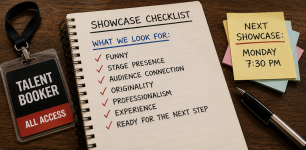
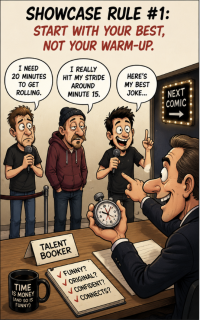
Absolutely! I think it’s a smart move to ask the judges—or any talent booker—about any content or language restrictions before you perform. In fact, I emphasize this in my workshops for a couple of important reasons:

  1. It shows professionalism – Being able to adjust your material based on the audience is key. Talent bookers appreciate that because it’s a sign you understand the business side of things.
  2. It gives you an edge over the competition – As much as I love talking about the supportive nature of the comedy community, let’s face it: not everyone can be hired. To stand out at showcases, you need to tailor your performance to the audience. And yes, comedy is a business, so that’s an important part of it.

For instance, let’s say there are only five spots available for a television show, but plenty of comics auditioning. Sure, being funny is crucial, but assuming everyone is equally funny and knows the right people, the deciding factor often comes down to whether you can adapt your set for the audience.

You wouldn’t perform the same set on The Disney Channel that you would on a Comedy Central Roast, right?

Here’s another example:

Did she really say that?

If you’re auditioning for a cruise ship gig, you wouldn’t walk on stage and start dropping F-bombs or overshare about your personal life. A lot of the onboard comedy shows are family-friendly—early evening performances with kids in the audience—and then later, after the kids are asleep, the adult shows take over. But if you can’t show you can adapt to both audiences, you likely won’t get the gig.

So, how would you know these nuances if you’ve never been on a cruise ship or worked in that environment? That’s where asking beforehand comes in handy.

Of course, if you’ve already found your comedy voice and certain venues aren’t a fit, that’s totally fine! I’m not saying you should always work clean. But if you know your material wouldn’t be acceptable for a specific gig (say, a family show), you’re not only wasting your time, but also taking an opportunity away from another comic who’d be a better fit for that audience.

Another example: when I booked comics for A&E’s An Evening at the Improv, we had specific guidelines for the performances. We’d go over them with the comics before the taping:

  1. Avoid making fun of God or religion – Our highest ratings were in The Bible Belt, and we didn’t want to risk alienating that audience. Plus, higher ratings bring in sponsors, so it’s good business.
  2. No bashing specific products – We couldn’t afford lawsuits, so no dissing a car brand or fast-food chain. Business, once again!
  3. Song parodies were limited – We had a strict 18-second rule to avoid paying song royalties for TV broadcasts.

So, what happened if a comic didn’t follow these rules?

If you watch reruns, you might notice some comics are only on-screen for 4 or 5 minutes instead of the usual 7. Why? They didn’t follow the guidelines, and that gets edited out. It’s an easy fix in the editing room, or even before the performance in the case of live auditions.

When it comes to working clubs, it’s almost always possible to check with the talent booker beforehand to ask if there are any material restrictions. They should be upfront with you because they know their audience best.

The goal for any talent booker is to find performers who can connect with their venue’s audience. This applies to comedy contests too, since the bigger business goal is to turn first-time audience members into repeat customers. And to figure out what works for their audience? You’ve got to ask.

Thanks for reading and as always – keep laughing!

Click on the banner below to sign up for Dave’s free newsletter.

For comments, questions about workshops and coaching please email – Dave@TheComedyBook.com

Seeking advice for a “stuck” comedy career

Hi Dave – I’m not so sure stand-up is for me. I think I may be better suited for improv acting such as The Groundlings, Second City, etc… I’ve always been told I’m funny and animated but am not so sure how to focus or direct it. I am interested in the profession / business and think I would enjoy it. However, I feel stuck! How do I know if stand-up is for me? What advice do you have as to getting in touch with my creativity and directing it in the right way / format? Any advice would be very helpful, welcomed and appreciated. Thanks so much. Best – C.H.

Feeling stuck?

Hey C.H. – You’re definitely not alone — a lot of people feel “stuck” when trying to figure out where their creativity fits best, especially in a field like comedy.

The truth is, the only way to really know if stand-up, improv, or anything else is right for you is to try it. Since you mentioned being drawn to improv groups like The Groundlings or Second City, that might be a good starting point. Most reputable improv theaters offer classes, and those classes are designed to help you channel your natural energy, timing, and personality into something structured and performance ready.

Some performers do both stand-up and improv, but most tend to gravitate toward the one that fits their style and personality. Improv is collaborative — working as part of a team. Stand-up is solo, where you’re in full control of the writing and performance. Neither is “better” — it’s about what suits you.

Learn the basics!

Taking a class is an excellent way to experiment without the pressure of an audience or audition. It gives you a safe space to explore, get feedback, and see what feels right. A good coach or instructor will not only teach you the basics but also give you an understanding of the business and help you shape your raw creativity into something focused.

Here’s why that matters:

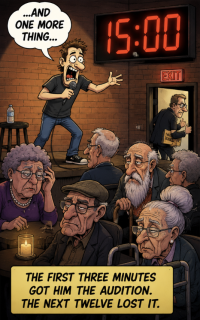
When I managed the monthly auditions at the NYC Improv, it was a lottery system — anyone could draw a number and get three minutes on stage. No experience required. Some people had prepared and tested their material. Others had never been in front of an audience, had no guidance, and no idea what to expect. And it always showed.

Two examples I’ll never forget:

One woman brought a roll of receipt paper on stage — like the kind you’d find in a cash register — and had written jokes on it. She’d read one into the mic, get no laughs, rip it off, throw it on the stage, and say, “Well, that didn’t work.” Repeat. It was painful to watch — but kind of hilarious in hindsight.

Another guy auditioned with a female mannequin dressed in lingerie. He set it on a stool, never acknowledged it, told a few bad jokes to uncomfortable silence, picked up the mannequin, and walked off into the night. Never saw him again.

Would they have done that if they’d taken a class or had some coaching? Maybe. But more likely, they would’ve had better instincts and more professional judgment.

So, my advice? If you’re interested in comedy — any form of it — and feel unsure where to start, take a class. It can open doors, sharpen your instincts, and help you figure out whether this is the right creative path for you. And even if it’s not, it’s still a fun and valuable experience that gets you unstuck and moving forward.

Thanks for reading and as always – keep laughing!

Click on the banner below to sign up for Dave’s free newsletter.

For comments, questions about workshops and coaching please email – Dave@TheComedyBook.com

Finding stage time in Los Angeles

Hey Dave – I won a contest for a trip to Los Angeles to appear in a commercial. Unfortunately, since I’m not in SAG-AFTRA (Actors Guild), I’m being buried in the background as an extra. I’m pretty stoked about the trip though. I’m hoping to hit one of the popular comedy clubs in Hollywood and see if they’ll let me do a guest set. I’m wondering if you have any recommendations. I’ll be there next week for six days. – S.

LA – where dreams can come true!

Hey S. – First, congratulations! Winning a contest for a trip to L.A. is very cool, even if they’re burying you in the background since you’re not in the actor’s union. Consider it motivation to get that SAG-AFTRA card — though, to be honest, I had mine for years and still got buried in the background plenty of times.

Here’s the scoop — and, of course, your experience might be different:

Unless you’re already a well-known or semi-known headliner or feature with credits and contacts who can vouch for you, it’s extremely tough to get stage time at the popular Hollywood clubs when you’re just in town for a week. The local comics have invested years hanging out, showcasing, networking, taking workshops, bringing paying audiences (“bringer shows”), and doing whatever it takes to get seen.

The bookers at clubs like The Improv, The Comedy Store, and The Laugh Factory need to spend their time on comedians they can actually book again soon. Giving a visiting comic a guest spot doesn’t help them much — unless you have a strong recommendation from a trusted regular (and I mean a real regular, not someone who’s just emceeing Monday open-mic nights).

I’ve been the talent booker at The Improv in L.A., so trust me — I know how this works.

So, to be blunt: it’s very unlikely you’ll score stage time at the big-name clubs during your short trip. But that doesn’t mean it can’t be a productive comedy visit.

Here’s what I recommend:


👉 Hit the open mics. L.A. has tons of them — Google “Los Angeles comedy open mics 2025” and you’ll find plenty. In fact, I just did and here’s a LINK. Always check that they’re still running — venues open and close fast. Call ahead or reach out to whoever books it. Some shows may ask you to bring guests; some may squeeze you in because you’re from out of town. You won’t know unless you ask.

👉 Check out the big clubs anyway. Even if you can’t get on stage, you should absolutely go watch a show or two. See how the pros work. Weeknight shows are best for watching up-and-coming comics; weekends are more touristy and packed with big names you can see on TV. You’ll learn a lot just by observing.

👉 Use this trip for inspiration. Wherever you find comedians, you’ll find comics hunting for stage time. It’s part of the grind. So, treat this trip as a chance to network, see what’s working in a major scene, and maybe make a few connections you can build on down the line.

Enjoy the commercial shoot, make the most of your free time, and soak up everything you can. Who knows? Maybe your next visit will be with a SAG-AFTRA card — and a real spot on the lineup.

Break a leg and have a blast in L.A.!

Thanks for reading and as always – keep laughing!

Click on the banner below to sign up for Dave’s free newsletter.

For comments, questions about workshops and coaching please email – Dave@TheComedyBook.com