Never promise what you can’t deliver

Hey Dave I need some advice… although I think I already know the answer. A booker asked if I could do an hour clean for corporate and 90 minutes for cruises. I’ve got about 40 clean. I already hurt myself recently when someone asked if I could headline an hour and I admitted I was more comfortable featuring. I want to say yes – but I don’t want to disappoint them or damage my reputation. At the same time, I’m worried that if I say no, they won’t call me again. What do you think? – D.

Are you being honest?

Hey D. – You’re right – you do already know the answer. And so does every working comic and talent booker who’s been around the business for more than a few open mics. The only difference is experience makes it easier to trust that answer.

Here’s the reality: nobody in this business wants to lose an opportunity. But one of the fastest ways to do exactly that is by overpromising – or worse, flat-out misrepresenting – what you can deliver.

If a booker tells a client, “This comic can do a clean hour,” that’s not a suggestion. That’s the product being sold. And if you say you can deliver it, it had better be true.

Because if it’s not… everyone loses.

Now, there are exceptions. Some performers can stretch with crowd work and genuinely carry an hour without a fully written set. If you’ve done that successfully before, that’s part of your act.

It could be a bomb!

But if you haven’t? A high-paying corporate show or a first impression with a legitimate booker is not the place to experiment.

For experienced comics, this is obvious. For those coming up, it’s where temptation creeps in.

You’re thinking: If I say no, I might lose the opportunity. But here’s the flip side: if you say yes and don’t deliver, you won’t just lose this opportunity – you’ll likely lose future ones too.

So, what’s the move?

Tell the truth.

A legitimate booker will respect honesty far more than a shaky performance. If they reached out, it means they’re already interested in working with you. This isn’t a “one strike and you’re out” situation – it’s the beginning of a relationship.

Use it.

Let them know what you can do right now. Ask to be considered for shorter sets. Stay in touch. Most corporate shows don’t even need an hour – 30 to 45 minutes is often the sweet spot.

And when you’re ready to deliver a full hour – or 90 minutes – you circle back and let them know.

That’s how careers are built.

Because this is a career. And careers take time.

Developing a strong, clean act for corporate and cruise work doesn’t happen overnight. It takes stage time, discipline, and a clear understanding that there are no shortcuts in this business.

From the booker’s side, I can tell you this: there’s nothing worse than putting a performer on a show who doesn’t deliver. The client is unhappy. The relationship takes a hit. And that comic?

Let’s just say they’re not getting a call anytime soon.

And yes… I learned that the hard way.

Thanks for reading and as always – keep laughing!!

*

Click on the banner below to sign up for Dave’s free newsletter.

Running The Light (Going Over Your Time On Stage)

Hey Dave – Without revealing my secret identity, I heard you talking recently about a comedian who went way over his time on stage—and you didn’t sound too happy about it. Safe to say he overstayed his welcome. Care to elaborate? – G.

Did someone give me the light?

Hey G – “Secret identity?” What is this, a spy novel? Don’t worry – I’ll protect your cover. But if you were really undercover, you’d know better than to eavesdrop on my conversations. I tend to go long.

Speaking of going long…

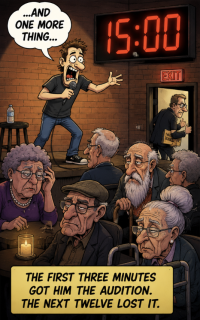
Want to guarantee you won’t get booked again? Ignore the light. Stay on stage. Do another 10… 20… maybe 60 minutes. After all, the audience obviously can’t get enough of you, right?

(And just in case sarcasm doesn’t translate in print – insert a big NOT! right there.)

Here’s the reality: stand-up may be a creative art, but it operates within a very structured business. And one of the biggest unwritten rules is simple – respect your time on stage.

Yes, there are exceptions. If you’re selling out arenas or headlining major tours, audiences expect a longer “concert-style” experience. Think of Bruce Springsteen playing three-hour shows – fans love it, and they paid for it.

But unless you’re at that level, stick to your set time.

Why? Because behind every comedy show is a tightly run operation. Clubs run on schedules – doors open, shows start, staff works, and everything from the kitchen to the bar to the box office is timed around the performance.

Only NO fans!

When a comic goes long, it throws everything off:

  • The box office has already closed
  • Food and drink service has ended
  • Staff is waiting (on the clock) with no way to earn tips
  • The next audience is lining up while the current one is still inside

And here’s something a lot of performers don’t realize: clubs build in “check spots” so customers can pay before the show ends. Run long, and you increase the chances of people slipping out without paying – which often comes out of the server’s pocket.

Not exactly a standing ovation from the staff.

I once had a comedian tell me he was “helping the club” by going an hour over – giving the bar more time to sell drinks. That logic deserves a bigger laugh than anything he said on stage.

The business simply doesn’t work that way.

The same goes for corporate and college gigs. Those events run on tight schedules. Go short, you risk not getting paid. Go long, you risk never getting invited back.

Bottom line:

Time isn’t just a suggestion – it’s part of the job.

For newer comics especially, sticking to your time on stage shows professionalism. It tells bookers and managers you understand how the business works – and that you won’t create problems.

And that’s what keeps you working.

I could go on… but I’ll do something that comic didn’t do.

I’ll stick to my time.

Thanks for reading and as always – keep laughing!!

*

Click on the banner below to sign up for Dave’s free newsletter.
Laughs and Bookings – the best revenge

Hey Dave – I had a great set last night, but one of the comedians who went on after me tore into me. It got really personal, and it honestly hurt. The people running the show asked if I wanted to go back on and get revenge, but I declined. Did I handle it the right way? – N.R.

Best revenge!

Hey N.R. – It sounds like the opening shot in a potential comedy war. Whether you want to crawl into the comedy trenches (a common comedy term — not mine) with this loudmouth depends on two things:

• Your onstage personality — your comic voice
• How you want to be seen onstage and offstage in this business

Maybe I’m naive, but after a few decades working with comedians, I’ve found this business to be far more supportive than people think. Sure, there are jerks — real pains in the butt — but I don’t know any career path that’s immune from that.

When this kind of behavior happens, it’s usually fueled by jealousy, ego, or a power trip. And here’s the irony: in my experience, the more power someone actually has in the business, the more supportive they tend to be of newer talent. That goes for comedians, bookers, and behind-the-scenes decision-makers.

Disbelief?

(I can practically feel the disbelief from some readers right now. This may turn into a future FAQ — I’ll let that thought marinate.)

For now, here’s the real issue:

Who are you onstage, and how do you want to be perceived by the people you work with — other comics and the people who hire them?

Comedians who are genuine friends tear into each other onstage all the time. That can be hilarious. At the NYC Improv, we could run a microphone into the men’s room and hold it over a flushing toilet when a friend’s joke bombed. The comic onstage ripped into us for the rest of the set, and everyone loved it.

  • That’s playful.
  • That’s earned.
  • That’s mutual.

What you experienced sounds different.

SPECIAL EVENT – ORLANDO, FLORIDA!

Standup Comedy Workshop at The Orlando Funny Bone:

Saturdays – February 7, 14 and 28 from noon to 4 pm.

Performance at The Funny Bone – Wednesday, March 4 at 7 pm

Space limited – for details and to register visit COMEDYWORKSHOPS.

*

When it’s mean-spirited, there’s no upside. An unprovoked attack is almost always about making him look better at your expense — jealousy, ego, or both.

There are two ways to handle this, and the right choice depends on who you are.

If you’re the kind of comedian who can verbally dismantle someone — truly dismantle them — then by all means, go for it. A skilled insult comic doesn’t absorb cheap shots; they return them with interest. Think Nikki Glaser, Marc Maron, Wanda Sykes, Dave Attell, Jeff Ross. An insult comic worth their weight can turn a heckler — or a fellow comic — into roadkill.

If that’s you, next time: aim for the throat.

But if that’s not your voice — onstage or in life — then you absolutely did the right thing by walking away.

Let this guy burn his own reputation. Comics don’t want to work with someone known for cheap shots. And bookers? They want the least amount of drama possible. Speaking from experience as a booker, I’ve passed on very funny non-headliners simply because they were a pain to deal with.

If someone else is just as funny — and easier to work with — that’s who gets the gig. Every time.

In a perfect world, your only focus should be becoming a better comedian. If someone chasing the same goal doesn’t like you, you’re probably doing something right.

Want revenge?
Get more laughs.
That leads to more bookings.

Use this moment as fuel. If your work ethic and focus pay off, maybe someday this loudmouth will be parking cars outside a comedy club, ripping into his coworkers — while you’re inside headlining.

Make it happen.

Thanks for reading and as always – keep laughing!!

SPECIAL EVENT – ORLANDO, FLORIDA!

Standup Comedy Workshop at The Orlando Funny Bone:

Saturdays – February 7, 14 and 28 from noon to 4 pm.

Performance at The Funny Bone – Wednesday, March 4 at 7 pm

Space limited – for details and to register visit COMEDYWORKSHOPS.

*

Click on the banner below to sign up for Dave’s free newsletter.

Being Influenced vs. Copying

Hey Dave – I’ve been working on material and continue to search for my comedy voice. Although I want to do some improvising, I want a good amount of material to work off of. Someone said I have a somewhat eccentric and iconoclastic persona and should take advantage of that. Therefore, I’ve thought about using Prof. Irwin Corey and Steven Wright as influences and been writing material similar to theirs, especially since I like it. However, I’m afraid I’m not using them as an influence but just copying them. Is there a thin line between the 2 or just between fishing and standing there doing nothing? – JK

Read and remember!

Hey JK – I was fortunate to work with the late, great Prof. Irwin Corey and with Steven Wright during my years at The NYC Improv. And as I always tell the younger comics: if you don’t know who those guys are, look them up. You’ll learn a lot about the history of stand-up and how much past performers have shaped the headliners we see today.

Both Prof. Corey and Steven Wright are incredibly smart and incredibly funny. I also know that if I ever tried to write like either one, I’d be lost – completely confused. My brain actually hurts just thinking about it. But I do have some thoughts on your question, so instead of standing here doing nothing, let’s go fishing for an answer…

Yes – there is a line between being influenced and copying. Ideally, it should be a wide one.

As Prof. Corey would say, “Let me explain…”

Prof. Irwin Corey

I often compare comedy to music. I’ve done this in my workshops, books, and more than a few FAQs. You can’t reinvent the wheel. Someone had to hum the first tune, and someone had to make the first joke. Musicians and comedians have been building on those firsts ever since.

One of my all-time favorite bands is The Rolling Stones. They’ve influenced countless musicians for more than sixty years – yet there’s still only one Rolling Stones. But even they started by copying their heroes: Muddy Waters, Howlin’ Wolf, Robert Johnson, Chuck Berry, Bo Diddley… the list goes on.

Did they copy? Absolutely.

They played a lot of covers early on. But that’s not what made them legends. Mick Jagger found his own voice. Keith Richards found his. Together they wrote new songs inspired by what they loved – but filtered through who they were.

That’s exactly how comedians develop. They start by emulating what they like.

Keith Richards isn’t going to play Bach when he grew up loving Chuck Berry. And based on how you described your humor, I doubt you’re going onstage with props like Carrot Top or with the kind of sharp-edged commentary Dave Chappelle is known for. You admire Corey and Wright, so of course they’ll influence you – just like Chuck Berry influenced the Stones.

But here’s the big difference between comedy and music:

Steven Wright

The Rolling Stones can play “Johnny B. Goode” in concert. A comedian can’t go onstage and say, “Here’s one from Steven Wright,” and then perform his jokes.

That’s not influence – that’s theft. And yes, there are comedians who do it. And most of us know exactly who they are. The respect level for joke thieves is somewhere below sea level.

Being influenced is not the same as stealing.

Creative artists build on what came before them. A Rolling Stones song might have a Chuck Berry riff or a Bo Diddley beat hiding in the background, but it’s still a Stones song. Likewise, comedians can’t help but be influenced by the style of humor they enjoy.

Carrot Top didn’t invent prop comedy. Every kid who ever held paper plates to their head and pretended to be Mickey Mouse dabbled in prop comedy. He took what he liked and built on it.

That’s what you need to do.

You understand your comedic style. It’s reminiscent of Corey and Wright, but you’re not Corey and you’re not Wright – and that’s the point. You didn’t grow up in their neighborhoods, their families, their jobs, or their lives. You have your own stories, experiences, personality, and point of view.

That’s where your material has to come from.

Don’t ask, “What would Steven Wright say?” Ask, “What do I think about this?” Respect your influences, borrow the sensibility you appreciate – but say things in your own words with your own brain.

When I worked in Los Angeles, I worked with Jim Carrey and Michael Richards (Kramer from Seinfeld). Both were massive Jerry Lewis fans. But neither went onstage yelling, “HEY LAAYYYDEEE!” That would’ve been stealing. But they did incorporate Lewis-style physicality, wild expressions, and pratfalls – filtered through their own personalities and experiences. And Jerry Lewis, of course, had been influenced by Chaplin and Harpo Marx.

That’s how influence works.

Use your natural mannerisms, your personality, and your experiences to shape your material. Don’t hold paper plates up to your head and hope the audience laughs – dig deeper. Think about why something is funny to you and how you see it. Then present that.

Everyone is influenced by someone. None of us are inventing the wheel – we’re just putting better tires on it. The key is understanding what makes you unique and exploring material that fits your comedic point of view.

Keep writing. Keep performing. Your comedy voice will emerge. And one day, when someone asks who influenced you, you’ll have your answer – just like every successful comedian does. The turning point is when you stop copying and start building on what inspired you in the first place.

Thanks for reading and as always – keep laughing!!

Click on the banner below to sign up for Dave’s free newsletter.

Bomb Alert! An Onstage Survival Guide

Hi Dave – What should you do if no one is laughing or if you realize that you are starting to bomb? – A.B.

Hey A.B. – Duck and cover.

On stage excitement!

Okay, that’s probably not the answer you were looking for. So, here’s another one that I’ve seen actually work.

But first, a quick definition.

Some readers may not know exactly what bombing means. It’s when you’re on stage doing your best to entertain — whether you’re a comedian or a humorous speaker — and absolutely nothing is working. The audience isn’t laughing, you start to panic, you begin to sweat, and you’re convinced everyone in the room hates you.

That’s Bombing 101.

And if you ever get used to it, you’re in the wrong business. I don’t know a single comedian who hasn’t gone through it. And if one claims they haven’t, they’re just playing a joke on you.

The dedicated comics never let bombing stop them. But the smart ones use it as a learning experience – usually discovering what not to do next time.

In my book Comedy FAQs and Answers, I talked with comedian George Wallace about this. Early in his career, he performed under the stage name The Reverend George Wallace and used a phone book as his “Bible.” The bit killed in New York City – until his first road gig in upstate New York.

The audience hated it.

He was booked for an hour, and he did an hour, but it was a mega-ton bomb. Driving home, he felt so bad he actually thought about steering off a bridge.

But that night became a turning point. He swore he’d never let that happen again. He rethought everything about his act and his stage persona. The “Reverend” was gone — so was the phone book. He decided that if he was having fun on stage, the audience would too.

And if the audience is having fun, you’re not bombing.

If you’ve ever seen George Wallace perform, you know what I mean. The man is practically immune to bombing.

How to Turn It Around – In Real Time

So, what should you do when it’s happening to you?

Here’s a proven technique I’ve seen big-name comics use to turn a tough crowd around: talk TO and WITH the audience.

Seriously — I’ve seen it more times than I can count. When your material isn’t connecting, stop pushing it. Put the script aside for a moment and start engaging the people in front of you.

A Story from The Improv

When I was scheduling comics for the Hollywood Improv, one of our most reliable — and funniest – acts had a rare off night. His material was top-notch, but for whatever reason, the audience just wasn’t responding.

To my surprise, he did something I’d never seen him do. He took the microphone out of the stand, walked to the front of the stage, and started talking directly to the audience.

He kept it casual: “Where are you from?” “What do you do for a living?”

Simple questions that led to funny exchanges and real conversation.

Once the audience was relaxed and engaged, he stepped back, put the mic in the stand, and went back to his material. This time, they loved him. They got the jokes, laughed hard, and he walked off to huge applause.

Why It Worked

When I asked him about it later, he reminded me that most comedians start out as MCs – hosting shows, introducing acts, and learning how to warm up a crowd. The MC’s job is to get the audience laughing and involved.

And the best way to do that? Talk TO and WITH them.

It’s a skill every comic should learn early – one that can save you in a tough room. I saw comedians use this technique not only in Los Angeles, but also when I managed The Improv clubs in New York and Cleveland. It’s not luck or instinct – it’s a learned survival tool.

The Bottom Line

When you feel the energy dropping or your set slipping away, stop talking at the audience and start talking with them.

It’s the quickest way to rebuild the connection – and remind everyone, including yourself, that this is supposed to be fun.

And if that doesn’t work? Well, there’s always the old “duck and cover” method.

Thanks for reading and as always – keep laughing!

Next online comedy workshop groups start

Monday, October 27 and Wednesday, October 29, 2025

Space is limited – for details, reviews and registration visit OnlineWorkshops

*

Click on the banner below to sign up for Dave’s free newsletter.