When a club booker asks, “How much do you want?”

Hi Dave – The talent booker for a comedy club sent me the following: “How long is your routine and how much would you want to come to (city) to do a show?” I do 45 minutes to an hour, but on the money question I have no idea how to answer them. Obviously, I’d want enough to cover airfare. Between you and me, I’d stay with my grandmother who lives near the city. Any ideas? Thanks! – B.K.

How much’ya want?

Hey B.K. – I know the club you’re talking about. They’ve been around for years and have a solid reputation. Since you didn’t mention this being a one-night private event or corporate booking, I’m assuming they’re asking about a weekend at the club.

And right away, you’ve run into one of the oldest games in show business.

The talent booker asked you a very open-ended question:

“How much would you want?”

That puts the pressure entirely on you.

Meanwhile, the person asking already knows the going rate for openers, features, and headliners because he’s been booking and paying comedians for years. Clubs that operate every weekend know exactly what comics are worth in their market.

So why ask you?

Because there’s always the chance you’ll come in low just to get the booking.

That’s especially common with newer comedians. Most comics who are still building credits don’t want to scare off a club by quoting too high a number. They’re thinking:

“I just want to get in the door. I’ll negotiate more money later.”

And honestly, that’s understandable.

This is part of the ongoing push-and-pull between bookers and developing talent. Comics with major credits, television exposure, and audience-drawing power can often name their price. Newer comics usually can’t.

That’s simply the reality of the business.

Years ago, when I was booking talent for The Great Lakes Comedy Festival, I contacted representatives for two major television stars for theater appearances. These were household names with hit sitcoms and enormous popularity.

The fees I was quoted were enormous — far beyond the budget of a startup comedy festival. One package even included a private jet to fly the comedian in and out the same night.

And none of it was negotiable.

As long as I’m on TV I set my own price, man!

That’s what leverage looks like at the top level.

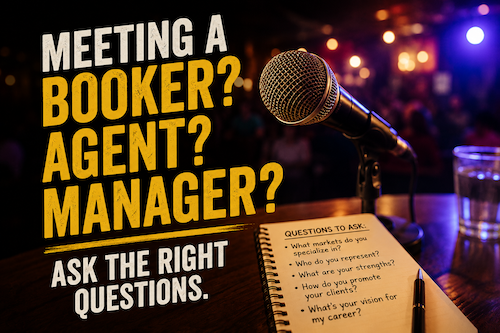
But for newer comedians and speakers, the key is learning how to ask better business questions instead of immediately throwing out a number.

Start with this:

“How many shows are you looking for me to do?”

That matters.

Five shows over a weekend is very different from one showcase appearance.

Then ask:

“What do you usually pay your first-time headliners, features, or openers?”

That’s a fair and professional question.

You should also do some research. If you know comedians who have worked the club — and you’re on good enough terms to ask — find out what the club typically pays.

Comedians don’t have a union. Information is often the only leverage performers have.

That said, be respectful. Some entertainers are private about money, and that’s understandable too. Don’t push if someone seems uncomfortable discussing it.

Ideally, the club would simply make an offer upfront:

“This is what we pay first-time features.”

That would make life easier for everyone.

But in the real world, bookers often want to see whether a comedian will undersell themselves first.

You’ll hear this same approach in the corporate, cruise, and college markets too. The difference is that established comedians in those worlds usually already have a set fee structure and know how to negotiate travel, hotel, meals, merchandise percentages, and other expenses.

Club work can be trickier because rates vary wildly depending on the venue, city, audience size, and your drawing power.

A comic consistently earning $1,000 a weekend has established a market value. A comic who’s still building credits may have less negotiating power — especially if the club is taking a chance on booking them for the first time.

That’s why you also have to look at the bigger picture.

Ask yourself:

  • Is this a strong credit for my resume?
  • Will I meet people who could help me get more work?
  • Is this an opportunity to expand into a new market?
  • Would I enjoy the trip personally?
  • Does staying with family reduce my expenses enough to make the deal worthwhile?

In your case, staying with your grandmother could actually become part of the negotiation.

If the club normally provides a hotel room, you might save them money by not needing one. The same goes for transportation if you can borrow a car while you’re there.

But here’s an important reality in today’s comedy world:

Cleveland Comedy Workshop June 2026

Stand-Up Comedy Workshop at The Cleveland Funny Bone

Saturdays noon to 4 pm – June 6, 13 and 27

Perform at The Funny Bone on Wednesday, July 1 at 7:30 pm

For details and registration visit CLEVELAND COMEDY

——————–

A lot of clubs no longer cover airfare the way they once did.

That means you absolutely need to calculate your expenses before agreeing to anything. Know what the trip will realistically cost you. Then compare that number against whatever offer the club makes.

From there, the final question becomes simple:

“Is this worth it for me right now?”

Only you can answer that.

My advice is to stay professional, be honest, and avoid throwing out a random number too quickly. Ask what they’re offering first. Let the booker show his cards before you show yours.

Then negotiate from a position of information — not insecurity.

Thanks for reading and as always – keep laughing!!

*

Click on the banner below to sign up for Dave’s free newsletter.

Getting Past Gatekeepers

Hi Dave – No, I’m not a comic. However, I’m a WGA screenwriter with a total focus on comedy screenplays. Can you tell me how to contact comedians’ agents about casting specific roles without running into blockades? I mean the blockades typically set up by the gatekeepers of those agents. Best – HK

Leave a message

Hey HK – The bigger the comedians (think celebrity) they represent, the bigger the agency blockade will be. When you make a call without prior personal contact or a great reference, plan some extra time on the phone for holding, transfers and a final request to leave a voice message and “Someone will get back with you.”

Does anyone really know who that “someone” is? I doubt it because they rarely call back without prior contact or reference. And unless you left a voice message with a great pitch (offer) that includes the opportunity for a lot of potential $$$’s (yeah, I’m jaded) you’ll spend a long time looking at your phone waiting for that return call.

Cold calling agents is usually a losing game.

That’s not cynicism. That’s how the business works.

But there is a reliable path forward — and it’s the same one that comedians use to get booked, discovered, and cast:

Be seen. Be present. Be part of the scene.

Come on in!

When I worked as a talent coordinator at the Improv clubs in Los Angeles and New York, I watched industry relationships form every night. Comics performed. Agents, managers, producers, and writers watched. After the show, everyone gathered, talked, and connected. Opportunities didn’t come from cold outreach — they came from proximity and familiarity.

Producers frequently contacted the clubs looking for specific “types” for TV and film roles. That’s why you sometimes see several comedians with similar looks or personas performing short sets in a row. They’re not just performing — they’re showcasing.

And once someone is seen in the right context, access changes instantly. Conversations happen. Meetings follow. Gatekeepers step aside.

Here’s the practical takeaway for writers looking to cast comedians:

Don’t start with the agent. Start with the comedian.

Go to the clubs. Watch performers live. Identify who truly fits your project — not just who’s famous. Introduce yourself professionally after the show. Be respectful. Be clear. Be human.

If a comedian is interested, they can open the door to their agent with one phone call. That personal connection does more than any cold pitch ever will.

Is networking easy?

No. The entertainment industry runs on relationships, persistence, and yes — a bit of schmoozing. There’s a reason “Let’s do lunch” became standard vocabulary.

But if it didn’t work, nobody would keep doing it.

For established names, access is automatic. For everyone else, access is earned through visibility and connection.

Be part of the scene.

That’s how you get seen.

And once you’re seen, you have a chance to be heard.

Thanks for reading and as always – keep laughing!!

TAMPA, FLORIDA

Standup Comedy Workshop at The Tampa Funny Bone:

Saturdays – March 14, 21 and 28 from 12:30 to 4:30 pm.

Performance at The Funny Bone – Wednesday, April 1 at 7 pm

Space limited – for details and to register visit COMEDYWORKSHOPS.

*

Click on the banner below to sign up for Dave’s free newsletter.

Clean or Dirty? You’d better know your audience

Hi Dave – I have one question. As a new comedian does my material have to be clean? – J.N.

Have a decision to make!

Hey J.N. — you’re not alone. This question comes up all the time, and new comedians ask it for a good reason: it matters.

Here’s the short answer upfront (because I’m rarely accused of giving one):

There is no right or wrong answer.

Comedy is both a creative art and a business, but before either of those things matter, there’s one primary goal:

Be funny.

How you get there is completely up to you.

A very famous comedian once told me (and I included this in my book How To Be A Working Comic):

“If you swear in real life, you’re going to swear on stage.”

That makes sense. If those words are already part of who you are, they’ll naturally show up in your act. But if they aren’t—don’t add them because you think they’ll make you funny. Audiences can smell that a mile away, and “trying to be edgy” is never as funny as being honest.

There’s a market for everything. Whether you choose to work clean or adult is a personal decision.

But since you asked – and once again, I’ve never been known for short answers – let’s look at this from a different angle.

We’ll call it…

Your Audience

But will they laugh?

You specifically said new comedian, so let’s start there.

When you’re beginning, your job is simple:

Get stage time. Learn how to write. Learn how to perform. Learn how audiences respond.

Along the way, you’ll encounter different rooms, different crowds, and very different expectations.

  • Some comedians love late-night, beer-soaked club crowds.
    Others prefer corporate events, colleges, or private functions.
  • Right now, it’s probably too early to know which lane you’ll ultimately choose—and that’s okay. But eventually, this becomes both a creative and business decision, because different markets hire different kinds of comics.

So here’s the real question behind your question:

Who do you want your audience to be?

Every entertainer has to answer that—not just comedians. As a creative artist, who do you want to make laugh? And as a businessperson (yes, that’s you), how will you build an audience that supports your work?

When you’re starting out, that audience could be anyone: open mics, bar shows, fundraisers, showcases. What matters most is experience. You don’t become a working comic by rehearsing in your living room or performing for the family dog.

You get better by getting on stage.

  • If they laugh, it works.
  • If they don’t, it doesn’t.

Audiences are honest that way—which is why stage time is priceless.

https://youtu.be/mu1F3ck5ZgE?si=AuPP001eW_GOKONc

Know the Room

Would your audience want clean material or adult material?

That’s not a moral question. It’s a practical one.

I’ve coached Born Again Christian comics and the most X-rated acts you can imagine. I don’t care which direction someone chooses—as long as they’re clear about it and performing for the right audience.

  • But make no mistake: there are rules in this business.
  • And those rules are made by the people who hire comedians.
  • You can’t do X-rated material on network television. Cable and satellite radio allow more freedom—but even then, context matters. The Disney Channel and The Howard Stern Show aren’t fighting over the same talent pool.

So ask yourself:

  • Where do you want to perform?
  • Who do you want laughing?
  • Which markets excite you?

You can work dirty—just don’t do it in front of grandparents who brought their grandkids for a fun night out. And don’t expect your clean, church-friendly material to crush in a late-night dive bar full of people upset that the bartender turned off cage-match wrestling for a comedy show.

Get the picture?

Experience Changes Everything

Many experienced comics can work both clean and adult. Why? Because their jokes are funny on their own—not because of an F-bomb. They can adjust based on the room.

A perfect example: cruise ship comics.

They perform family-friendly shows before and after dinner, then switch gears later that night for adult-only crowds. Same comedian. Same brain. Two very different sets—sometimes just hours apart.

That kind of flexibility comes from experience.

And one more thing to keep in mind…

The people who hire comics for corporate events, banquets, and private functions pay far more than the beer-soaked guy booking a bar show. That’s why many working comics love corporate gigs.

On the other hand, an uncensored Netflix special or becoming a regular guest on a show like Stern can launch a career just as fast.

Different paths. Same requirement.

So… Clean or Dirty?

As a new comedian, here’s my advice:

Focus on writing funny material—material that works with or without a few choice words. Develop jokes that stand on their own. Learn how to adjust your delivery depending on the room.

Then ask yourself:

  • Would I rather perform at a business luncheon—or a late-night dive bar?

Neither answer is wrong. But knowing your audience will help you find the right one.

And that’s where real comedy careers begin.

Thanks for reading and as always – keep laughing!

Next online comedy workshop groups start

Wednesday, February 11 and Monday, February 16, 2026

Space is limited – for details, reviews and registration visit OnlineWorkshops

*

Click on the banner below to sign up for Dave’s free newsletter.