
Hey Dave – I was reading your newsletter today and I’m wondering… What’s the difference between a Headliner vs. a Feature Act? Thanks – DS

Only west of Manhattan!
Hey DS – Money. Next question?!
Okay… okay… sorry for trying to be funny. That’s actually a good question for comics starting out AND in certain areas of the comedy scene. And the above is only part of the answer. There’s more to it, so let me explain with a true confession.
When I worked in the comedy biz in NYC I didn’t know the difference either. In fact, there was never a reason to bring up the term feature act. The comics worked their way through the open-mics and auditioned for the major clubs in the city. You can Google for a list – but off the top of my head from those days we’re talking about The Original Improv, Comedy Cellar, Catch A Rising Star, The Comic Strip, Caroline’s, Dangerfield’s, The New York Comedy Club and Stand-Up NY.
I’m sorry if I forgot anyone…
I was manager of The Improv, which in NYC (like the others) was a showcase club.
Yes, most of our audiences were made up of locals and tourists (like the others) but comics knew it was an important place to be seen. On any given night there could be industry people such as agents, managers, producers, and casting directors watching. We also scheduled showcases (auditions) for The Tonight Show, Late Night with Letterman, HBO, MTV, The Today Show – and plenty of others.
As I said – it was a good place for comedians to be seen on stage.
Non-industry nights were Fridays and Saturdays. This means the audiences (two shows Friday and three on Saturday) were pretty much local comedy fans and tourists (we’ll call them out of town guests from now on). Instead of going to a movie, they could see a live show – without paying high prices for Broadway show tickets. So, the comics were booked in advance and mostly “A-Acts.” In other words, they were our headliners, some already famous from television and movies, and the industry people already knew who they were. These comedians already had agents, television credits and were not “new faces” waiting to be discovered.

Not a feature act
Let’s put it this way. You, me, and everyone on the planet knew who George Carlin was, so there was no reason for him to showcase for industry people. If you wanted to hire him, all you needed to do was call his agent and pitch the project you had in mind.
Make sense? Okay…
Tuesdays, Wednesdays, and Thursdays were the usual showcase nights. There would be several A-Acts doing 20 minute sets to guarantee good shows. But this is also when industry people and audiences would see the up-and-coming comics. They would be given anywhere from 5 to 10 minute sets and we could have as many as 10 to 15 comics go on stage in one night. Since we could stay open until 4 am the length of the show depended on how many people were still in the audience.
So, what I’m trying to say is in NYC (at that time anyway) we didn’t deal with or use the term feature acts. They were either A-Acts or newer comedians working their way toward becoming an A-Act.
The difference in terms happened when comics worked on the road – clubs outside of New York and Los Angeles. And since that wasn’t on my personal radar at the time, I never dealt with it.
It wasn’t until I got to Los Angeles and started working for Budd Friedman that I learned about bookings in the other Improv comedy clubs. The venue on Melrose Avenue was a showcase club like New York, but the other Improv clubs across the country did shows with only three comedians.
Only THREE comics?
Yeah – I was surprised too! My mindset was like the old New Yorker Magazine cover from 1976 – that is still a popular poster around Manhattan decades later. Basically, Manhattan residents could look west from 9th Avenue (BTW – The Improv was located just east of 9th Ave) and not really acknowledge anything until the Pacific Ocean.
Stuck up? Well, when everything you need is on one island it just becomes a way of life. But I regress…
Outside of NYC and LA, the clubs in other cities scheduled three comics – an opener (MC or host), feature (middle) and headliner (closer).
Every club I’ve ever managed or booked – including showcase clubs – has an MC (Master of Ceremonies is the proper showbiz term). That’s the comic who opens the show and warms up the audience. They’re also the ones required to make the announcements. You know – tell the audience about drink specials, future shows, and other “from the stage” advertisements.
Don’t forget – the “proper” term for showbiz is show BUSINESS.
The headliner closes the show. That’s the star act – the comic the club is advertising and the one most of the audience is paying to see.
So, who would be considered a feature act? You can guess – right? That’s the comic in the middle – between the opener and headliner. They do more time on stage than the opener – and less than the headliner.
And that takes us back to my first answer – money.
The feature act is paid more than the opener and less than the headliner. And there’s never a mix-up over that because it’s in the contracts, which is another matter I don’t remember dealing with in showcase clubs. In NYC you showed up, did your set, got cab fare and a sandwich – and thanked the club when you taped a special for Comedy Central.
Thanks for reading and as always – keep laughing!!
*
Click on the banner below to sign up for Dave’s free newsletter.



 Hey MB – The simple answer is this: showcases exist to find talent.
 Rather than spending weeks reviewing hundreds of submissions, producers could schedule one showcase and watch a carefully selected group of comedians perform live.
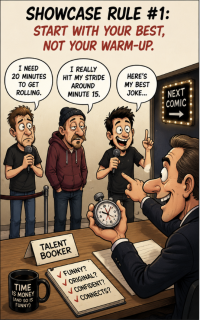 A successful showcase can lead to paid work, television appearances, club bookings, corporate gigs, or even representation from an agent or manager.
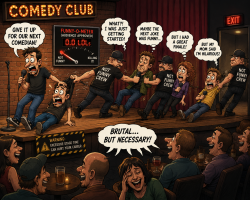 Of course, some comedians complained that three minutes wasn’t enough time to show what they could do.
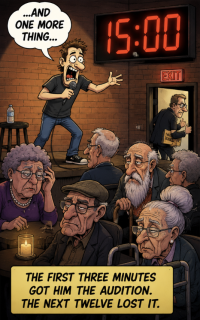 Bring your A-game immediately.


