Open Mics for Corporate Comedians

Hey Dave – Last week you talked about ‘what is corporate comedy material.’ I would also like to learn about getting into doing comedy and humorous keynotes at corporate events. – E.M.

Not a late-night open mic audience!

Hey E.M. – Let’s pick up where we left off. Last time, I talked about the kind of material comedians need to develop to get hired for corporate events. But the bigger question is: how and where do you develop that kind of act?

Here’s the challenge: the type of material you’ll need—G to PG (max) and often with a business-related angle—doesn’t always work in the usual late-night, beer-soaked open mics. But that doesn’t matter, because those crowds aren’t your audience anyway.

Your real audience consists of business owners and event planners, and you’ll find them at morning, afternoon, and evening business or association meetings. Instead of bars at midnight, look for stage time at Rotary breakfasts, Knights of Columbus luncheons, and College Club dinners—just to name a few. Almost every town has groups like these, and they’re always looking for speakers or entertainers.

Bonus incentive!

These slots usually run anywhere from five to twenty minutes—often slotted between the entrée and dessert.

Here’s the key: treat these meetings like open mics. Don’t expect to get paid (at least not at first). The magic word for getting these spots is FREE. Offer to do a clean five-minute comedy set before their featured speaker, and you’re far less likely to hear the other magic word in comedy: NO.

In my own experience, I was almost never turned down. The only exception was a 90-year-old Rotary member in the Midwest who thought his club wasn’t interested in anything except insurance, fertilizer—or both. When I explained I spoke on humor and creativity, he sounded ready to have me arrested for being anti-American. I politely thanked him, called another Rotary club, said the word FREE, and got booked right away.

As you continue writing and testing material that works in this environment, aim for longer sets—up to the typical 20-minute featured program. From my experience, most organizers welcome a variety of speakers. After all, you can’t have insurance, fertilizer, or a combo of both every single week.

After doing these enough times—and enjoying more than my fair share of free breakfasts, lunches, and dinners—I had built a solid corporate program. From there, it was a matter of networking and promoting, and before long, I was booking paid gigs. That never would’ve happened if I had tried to shape my corporate act at late-night open mics.

So, if you’re serious about the corporate market, this is a proven way to get started. And, by the way, the advice is FREE. If you can make an audience laugh at 7:30 in the morning over scrambled eggs and coffee, you’ve got a real shot at making it in the corporate comedy and keynote world.

Thanks for reading and as always – keep laughing!

For details (and free 10-minute consultation) visit Private Coaching.

Click on the banner below to sign up for Dave’s free newsletter.

What Is Considered Corporate Comedy Material?

Hi Dave – You’ve talked about working in the corporate market as a comedian or humorous speaker. What is considered corporate comedy material and what is not? – B.E.

Living on the edge?

Hey B.E. – That’s a great question, and honestly, one I don’t hear in such a general way. Usually it’s more specific, like “Is this particular joke okay for a corporate show?” But since you asked broadly, I’ll give you the broad answer first.

When it comes to corporate work, the golden rule is simple: work clean. I’ve said it many times before, and I’ll keep saying it because it’s true.

There’s been some debate on social media about whether dropping F-bombs will ever become acceptable at corporate functions. My opinion? The people saying that are a little F-bombed themselves. It’s not happening now, and it won’t anytime soon. Sure, there may be rare exceptions with an “edgy” company (think Comedy Central), but if you want steady work in the corporate market, clean material is the standard. That means no F-bombs, and no routines where the F-bomb is the punchline.

Now, let’s get into what corporate audiences do look for. A lot depends on the event and its theme.

Follow the rules.

From my experience as both a booking agent and a corporate speaker:

  • Comedians are often hired for holiday parties, retirement banquets, and award ceremonies. The material can cover almost anything—marriage, kids, sports, current events—as long as it’s clean and fits the mood. But it’s important to know the theme. If it’s a holiday party, the client might want some holiday references mixed in. At a retirement banquet, comics who can roast, ad-lib, and personalize a few jokes usually do well. The key is to keep the laughs lighthearted—no embarrassment, no hurt feelings.
  • Humorous speakers are different. They’re brought in for their message—stress relief, communication, networking, leadership, tech training, you name it. With humor, they become entertaining as well as informative. These speakers might give keynotes, run breakout sessions, or even full-day training workshops. Their material comes directly from their area of expertise, with comedy woven in to keep the audience engaged.

So, to put it simply:

  • Comedians = entertainment. Be funny, be clean, and tie in the event’s theme when needed.
  • Humorous speakers = infotainment. Deliver useful content, but with humor so it sticks.

That’s the general answer to your general question, B.E. If you’re serious about working the corporate market, start by keeping your act clean, know the event’s theme, and always make sure the CEO (or whoever signs the check) leaves happy.

Thanks for reading and as always – keep laughing!

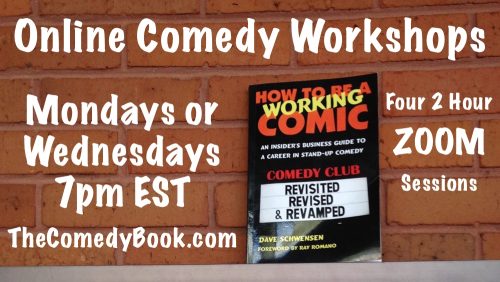
For details about September – October 2025 online comedy workshops check out this LINK

Click on the banner below to sign up for Dave’s free newsletter.

For comments, questions about workshops and coaching please email – Dave@TheComedyBook.com

Corporate Comedy: Think big but start small

Hi Dave – I just joined your email list. I do humor and did my first two stand-up open mics… rough crowd. Someone threw a cup of ice at one of the other comedians. My goal: to get some gigs entertaining at travel conferences. I have a bunch of funny travel stories. Any idea who I approach? A booking agent? I’m new to this, so any thoughts are appreciated. – R.R.

Traveling for work!

Hey R.R. – Only one cup of ice and you call that a rough crowd? Welcome to open mics. No wonder you’re aiming for conferences and corporate gigs. At those, the worst you’ll get is an icy stare if you’re not funny.

Here’s the thing: two open mics is a start, but you’ll need a lot more stage time to develop timing, delivery, and the ability to dodge both ice cubes and awkward silence. That only comes from performing – over and over.

Since you want to specialize in funny travel stories, focus now on two things:

  1. Writing – Create material that you find interesting. If it doesn’t grab you, it won’t grab the audience.
  2. Short sets – Start with five minutes. Think of it like writing a book: one chapter at a time. Use “color” – vivid descriptions – to take the audience on the trip with you. And make it funny.

Once you’ve got that five minutes, try it live:

  • Don’t avoid traditional open-mics, but search out stage opportunities with “real” audiences (and not just other comedians waiting their turns to go on stage).
  • Offer to speak for free at local business groups, networking breakfasts, luncheons, or special interest clubs. These are the “open mics” of the corporate world.

Work for free?

Why free?

Because you’re practicing, and they’re doing you the favor by giving you an audience. Keep it squeaky clean – G-rated – because in the corporate market, that’s the only way in.

When that first five minutes works, write another. Soon you’ll have ten… then fifteen… then a full conference-ready set.

Now – about booking agents.

Don’t call them yet. They need proven, audience-tested acts. You’ll know you’re ready when free gigs turn into paid ones – when people in the audience hand you their card and say, “Are you available for our event?” That’s when you start quoting fees and agents start calling you.

Bottom line:

  • Think big, start small.
  • Write, perform, adjust, repeat.
  • Build a proven act before chasing agents.

When the offers start rolling in, you’ll be ready to ask the magic question:

“Where, when, and how much are you gonna pay me?”

*

Thanks for reading and as always – keep laughing!

For details about September 2025 stand-up comedy workshop at The Cleveland Funny Bone check out this LINK!

Click on the banner below to sign up for Dave’s free newsletter.

For comments, questions about workshops and coaching please email – Dave@TheComedyBook.com

Personalizing and Customizing Performances for Corporate Events

Hi Dave – Can you give us a few examples of how to work event themes into your material for a corporate gig? What is the process like? – MD

Hey MD – When it comes to performing at corporate events, I’ve always believed that personalizing your act or presentation to fit the audience and occasion is essential. It’s not just something I do – major entertainers do it too.

How did they know that?

For example, several years ago, my cousin attended a corporate event in Florida where Jay Leno was the surprise performer. Having Leno on the bill was impressive on its own, but what really elevated the experience was when he mentioned the company by name and even referenced a few of the executives in the audience. Suddenly, it wasn’t just a great show – it felt like a one-of-a-kind event designed just for them. It’s one thing to hear a big-name comic joke about your city or current headlines, but when they reference your business or someone sitting a few tables away, it becomes unforgettable.

Event planners, executives, and employees love that kind of attention. It reflects well on the company, adds energy to the event, and makes the entire experience more engaging. A key way to make this happen? Performers who know their audience—and show it.

This is what we mean when we talk about personalizing or customizing material. Even if a comedian or speaker is delivering the same core act they performed a thousand miles away the night before, they’ll weave in references to the location, event theme, and audience members to make it feel special.

Think of it like this…

I’m a classic rock fan, so let’s use The Rolling Stones as an example. On tour, they stick to a fairly consistent setlist. That’s necessary – stage lighting, video screens, pyrotechnics, and choreography all depend on knowing exactly what song is coming next and where Mick and Keith will be standing when the fireworks go off.

It’s the same with big-name speakers or comedians. They have a program that works. Corporate clients are paying for that proven performance. But that doesn’t mean it can’t be tweaked to suit the crowd.

If the Stones are playing in Los Angeles, you can count on Mick kicking off with, “Hello Los Angeles—we’re rockin’ tonight!” Next week in New York, he’s not shouting out L.A.—he’s calling out New York City. A simple change, but one that creates connection.

Here’s another example from my own experience:

When I book comedians from New York or L.A. to perform near Cleveland, many of them aren’t familiar with the local scene. But the savvy ones will ask how they can relate to the crowd. One question I often hear:

“What’s a suburb near Cleveland that locals make fun of?”

No offense intended, but I usually tell them “Parma.” Then during their act, the comic tosses in a joke referencing Parma—and suddenly the audience feels like, this comic gets us.

Now here’s the truth: that comedian may not know anything else about Parma. But next week, in another town, they’ll ask the same question and swap in a different local punchline. That’s personalizing the performance – and it works. Audiences respond to it. Talent bookers and event planners love it.

What I Do for Corporate Bookings

When I book a comic or speaker for a corporate event, I include a short questionnaire with the contract. It’s the best way to learn about the audience and the company. Based on the answers, I’ll ask the performer to incorporate relevant material into their act.

Here are a few examples of what I might ask:

  • Is there a theme for the event?
  • What should we know about the city or event location?
  • Who are some key people in the company?
  • Are there any individuals you’d like us to spotlight – either for recognition or audience participation?
  • What are the company’s products or services?
  • Is there a rival company we can (respectfully) poke fun at – or one we should avoid mentioning?
  • Where do employees like to hang out after work?

The depth of personalization depends on how much the client wants to share – but even a few specific details can go a long way in creating a stronger audience connection.

What About Customization?

Earlier, I mentioned both personalizing and customizing. Here’s the difference:

  • Personalizing involves adjusting an existing act or presentation to reflect the audience or event.
  • Customizing means creating brand-new material specifically tailored to the client’s message, goals, or theme – and yes, it usually comes with a higher fee, because it involves extra time and effort.

A customized presentation starts with a deep dive. I’ll often interview the client, event planner, and key team members to learn about the company culture, industry challenges, and internal goals. The performer then builds their presentation around that material, while still staying true to the style that got them hired in the first place.

For example, if a speaker is known for expertise in communication, the client won’t ask them to build a presentation on accounting. Similarly, if they hire Carrot Top, they’re not going to request a prop-free, TED Talk-style set. You get what you’re paying for – but a smart performer can shape their material to suit your exact needs.

Just like The Rolling Stones wouldn’t skip Jumpin’ Jack Flash in concert, comedians and speakers know their core act is what the audience expects. But with the right information, they can personalize – or fully customize – it to turn a good performance into a great one.

And that’s what makes a corporate event truly memorable.

Thanks for reading and as always – keep laughing!

Click on the banner below to sign up for Dave’s free newsletter.

For comments, questions about workshops and coaching please email – Dave@TheComedyBook.com